Red Cedar
More apocalypse, less angst
Post #3232: Run, Lift, Weave, Write, Repeat
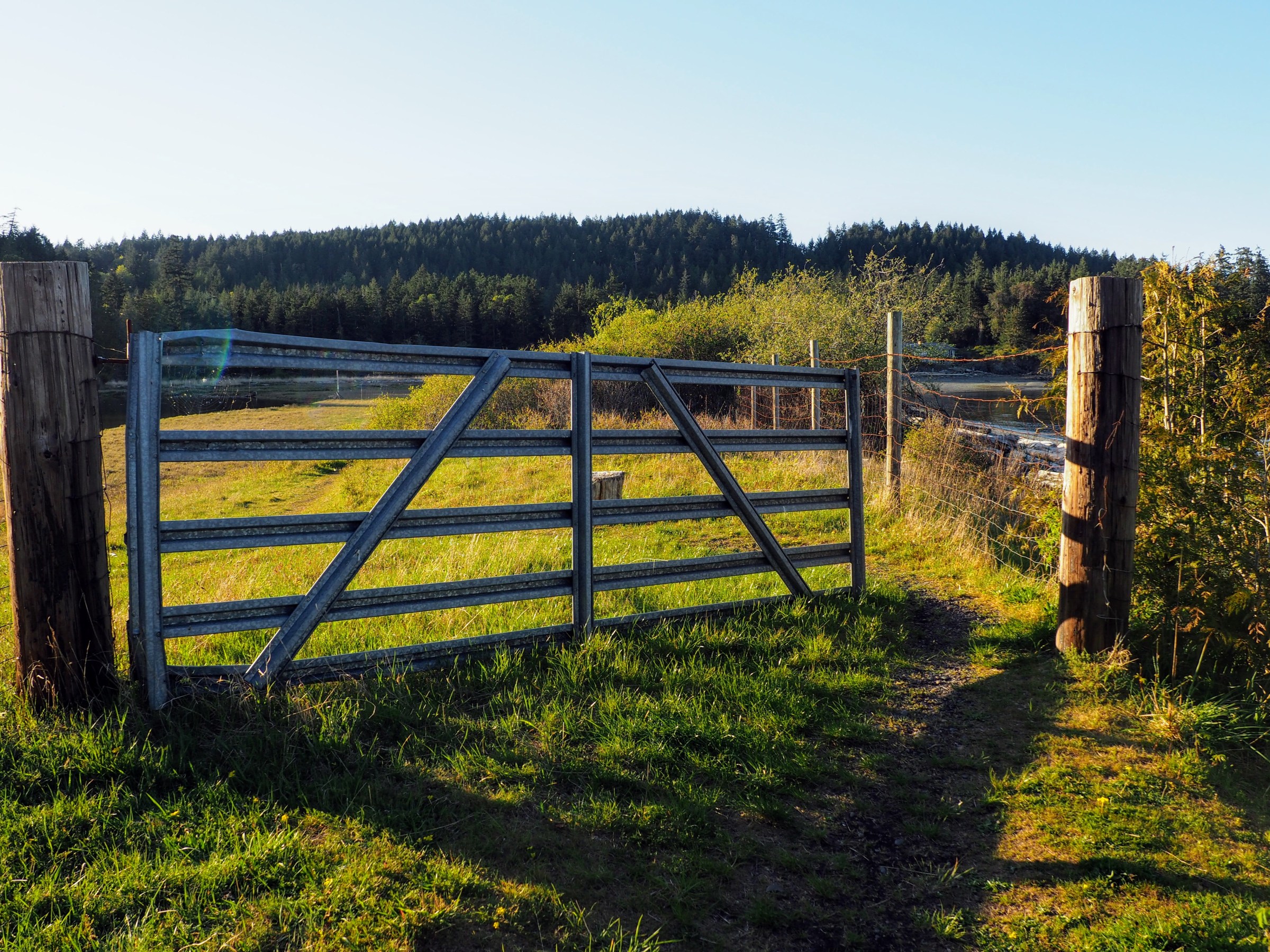
According to the forecast, the weather is about to turn to rain – but what a glorious ten days it has been. Even though I’ve had to work, I’ve managed to get outside for a kayak, a run, and a bike ride in addition to getting some solid gardening (read: weeding) time in this week.
Until Tuesday, I hadn’t been for a run in six weeks. Even though my Doctor cleared me for running a month ago (no bone deterioration, nothing to worry about around the embedded plate), I wasn’t really feeling it. But in the last couple of weeks, the pull has returned and so I’m going to start fitting runs into my workout schedule again. In particular, I miss covering long distances on my own propulsion and seeing my island-world at that pace. As the weather warms and the mornings lighten, I hope to fit runs in before work to escape the heat, but for now anytime is a good time to get the runners back on.
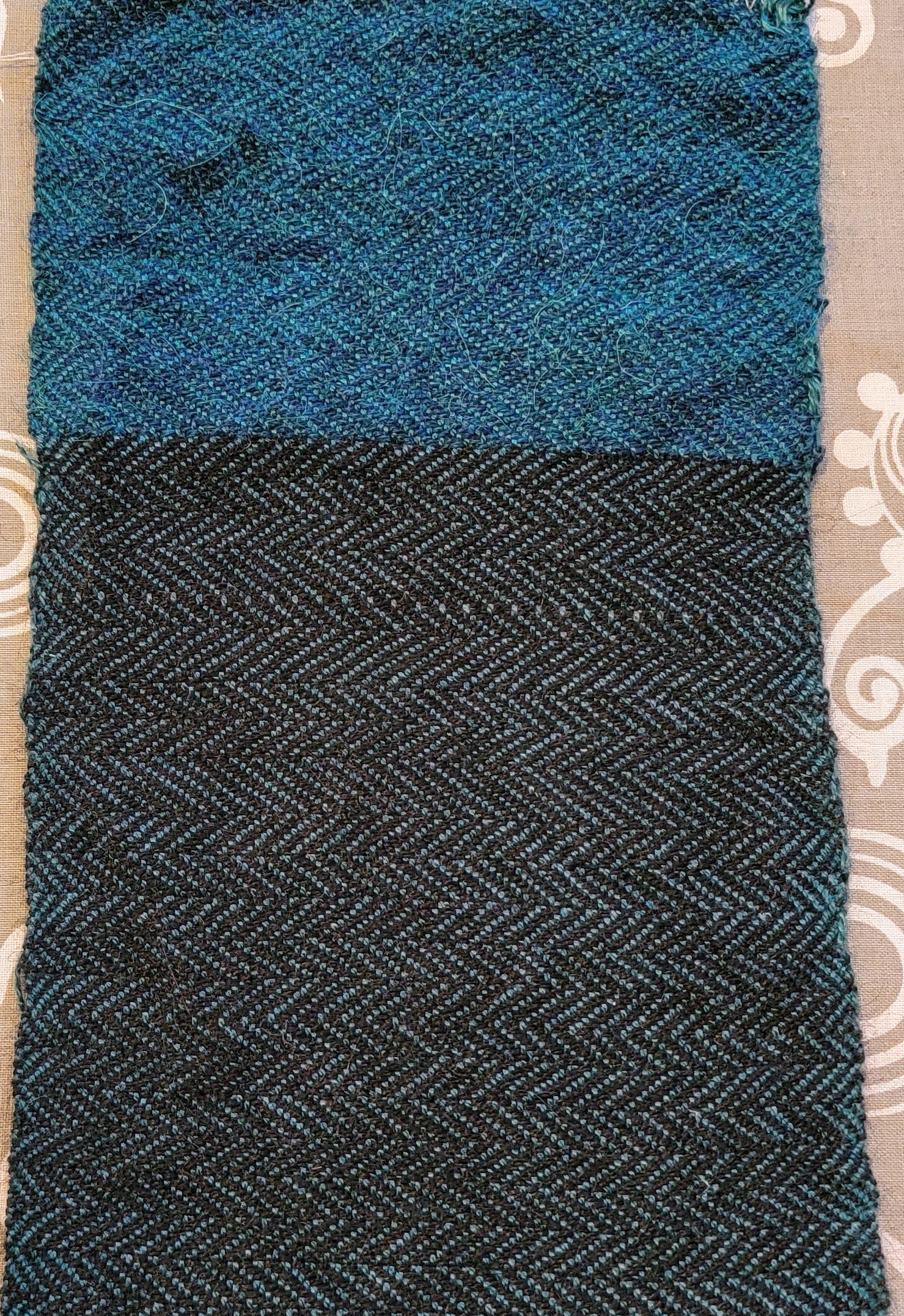
I’ve continued at the loom this week with some sampling. At the start of the year I set an intention to use as much “stash” yarn, fabric, and weaving material as possible. I have several projects worth of stuff in my cupboards, and before purchasing more, I’d like to use at least some of what I have. Case in point, I have some beautiful lace weight alpaca yarn in three colours, as well as some tencel yarn (also in three colourways) that I bought for some project that never happened. In the world of making fabric, it’s always a bit of a crapshoot how things are going to work when you put them together, and it’s a lot of work (and wasted material) if you get it wrong – which is why weavers create samples and sample books. My samples this week included using the tencel fibre as a warp (it’s quite strong) with the alpaca fibre as weft, woven at two different setts (densities). I’m quite happy with the result of the less-dense sett woven in a herringbone twill. It has excellent drape and after washing/fulling it is very soft. Once I get the big loom cleared off (it’s got a bathmat on it that I’ve been hung up on weaving due to a problem with how I tied up the treadles) I will be putting the first of the three shawl projects on. In the meantime, I’m warping the small loom with some spring-coloured hand towels this weekend.
Writing continues every day, whether I feel like it or not. Somewhere this week I ran into this quote which sums up my approach to essays and book ideas and the craft in general. For all the good writing I do, there is a ton that gets thrown away and though it sometimes feels like a bit of a churn, it is necessary to anything good getting done.
If you want to have good ideas you must have many ideas. Most of them will be wrong, and what you have to learn is which ones to throw away.
Linus Pauling
Relatedly, music practice requires that one must sound awful a great deal of the time in order to eventually sound good. I am working on some violin pieces currently that make me feel bad because I play them so poorly, but there is no way to play them better without going through this awfulness (which can go on for weeks and months). Just this morning I sent an inquiry form to the Victoria Conservatory of Music to see if I could find an appropriate teacher to meet with online and eventually in person in order to get some help overcoming my technical limitations. While poking around the site it was hard not to notice that the director of the strings program there is one of my contemporaries – someone who studied with the same teacher as me, and who I sat beside in youth orchestra when we were thirteen (I was second chair to his first chair, first violin – he was a much better player even then). Though I have no aspirations to great playing at this point in my life, I would like to return to playing classical music with other people at some point and that requires a greater skillset than I currently have. I’ll see if the Conservatory matches me with someone; I don’t know how many folks they have there teaching adults or how many of them are teaching virtually.
Beyond that, it’s been a week of regular work, decent food, and finishing a bunch of books that I’ve been reading (plus starting new ones). I’ll be glad when the warmer weather is here to stay, but for now we could use some spring rain to get the plants and trees really going before we are plunged into the summer dry season.
Post #3231: No Self isn’t No Identity

In the last year or so, I’ve been troubled by some of what I’ve been hearing from the corners of North American Buddhist and meditation circles with regards to social justice and identification to a racial or social group. Most recently, a popular secular meditation teacher, literally called politics motivated by racial identification “an ethical and psychological dead end” and “a mental illness“. I am not going to drive you to that individual’s site, but you can read Matthew Remski’s piece for more information. This isn’t the first white meditation teacher to use the Buddhist doctrine of no-self to chastise politicized communities. Brad Warner, a Zen teacher whose writing I really connect with on some levels, questions the right of individuals to have their gender self-identification respected by others, and then goes on to describe how he has worked at getting over this problem of the need to identify. (In a post I can’t locate at the moment, he also suggested that there is no room for politics in the Zendo).
Now, I’m not a popular meditation teacher, nor do I claim enlightenment, but when I read or hear these kinds of pronouncements I prickle because no matter how definitively they speak to their particular audience, they do not represent the totality of Buddhist thought on the matter. Additionally, these teachers rely on us to believe their profound insight gives them access to a truth the rest of us don’t have, and therefore accept their position as inarguable. In this case, we are left with some pretty retrograde ideas masquerading as spiritual enlightenment: there simply is no place in our culture for a politics that coalesces around racial or cultural identification; we must not have discussions about politics in our Zen centers; political activity is frivolous. Etc.
Though both of these individuals are experienced meditation practitioners, they seem confused about the difference between attaining the state of no-self in our practice, and how we are identified, and thus treated by our society. As a cis-gendered woman, I don’t have to tell people I’m female to be treated to the sexism of my society. A visibly Indigenous individual does not have to tell others what nation they originate from on Turtle Island before they encounter the racism of the settler state. This has nothing to do with our spiritual insight (though what we do after we encounter abuse based on identity will be informed by our vows and our practice).
I will illustrate using the example of feminism, without which I would not have the right to vote or control my reproductive body (or work, or drive a car, or wear pants). The feminist activism I have engaged in over the course of my life is not borne out of a need to identify myself with other women, irrespective of context. The joining of women in a political movement called feminism to march, protest, petition, and demand change comes about because we want a kind of justice that is otherwise denied due to our body parts, or self-presentation that challenges the masculine in some way. In other words, we may come together as female-identified people, creating a politics of identity, but it’s not for the sake of identity in and of itself. It’s because we want to change something. And wanting political change is not a kind of mental illness, nor is it “superficial and needlessly noisy.” It is necessary to the liberatory project we find in the roots of our Buddhist practice.
No-self is a state we might access in our practice, and I believe I have had glimpses of understanding the bottomless well that appears when body and self drop away. This tells me something about my experience of the Dharma through practice, and I can take that understanding into my daily life in various ways. It’s a radical state (or non-state) to be sure. But even having touched no-self in my practice, it doesn’t mean that in my everyday life I want to live the politics of misogyny, exclusion and physical violence enacted at my gender.
In order to understand this dilemma of no-self versus identity in political movements, I turn to the book Radical Dharma : Talking Race, Love, and Liberation, a work by three non-white Buddhist teachers in the United States. In it, Zen teacher Rev. angel Kyodo williams unpacks the shortcoming of sticking too closely to the purity of our spiritual traditions as the sole way to escape our hardwired human tendencies. She says, “neither Christianity nor any other faith alone can deliver us into a systems analysis that can unravel the massive entanglement that white supremacy is in every aspect of how we think, feel, dream, and act toward ourselves and others based on our perception of their place in the social order. Rank is still the evolutionarily Neanderthal mode by which our social and religious cultures are organized, and it systematically undermines every enlightened impulse we have. ”
She challenges modern Buddhist teachings that promote “the acceptance of a ‘kinder, gentler suffering’ that does not question the unwholesome roots of systemic suffering and the structures that hold it in place.” Roots that are firmly planted in racist and colonial structures that persist in how we are identified, which means that a one necessary locus of political change is going to be found in those identifications.
I practice in the Soto Zen tradition and am attached to the lineage with North American origins at the San Francisco Zen center (first brought by Shunryu Suzuki in the 1960s) . How I stumbled from secular meditation practice into a whole scale commitment to Zen is a story for another day, but one thing I discovered early on is that my adopted tradition does not shun discussion of real-world issues. In dharma talks, tea-circle, or “engaged” practice discussions, we are free to raise the worldly oppressions and identifications that we work within. We discuss how to approach these issues through the lens of our precepts, and to develop skillful means when approaching social problems. We commiserate with the suffering that racism, sexism, transphobia, ecocide, and other painful manifestations bring to one another’s lives. I have never once encountered any of our long-committed teachers suggest that someone’s identification with their race or gender expression was a sign of mental illness, or that activism as I have participated in it is superficial and needless. And while it is true that founding teachers like Norman Fischer do not speak out through social media on every issue that arises, to listen to his talks (all freely available online) is to understand how we thread our worldly lives (including our politics) into our understanding of the dharma.
We are fortunate to have choices about what kind of teachers we follow in this era. There is no monolithic church, no single mode of faith. When one person proclaims they know the truth, it is a simple matter to turn elsewhere and listen to the guidance of others. I hope that in the modern Buddhist and meditation world we continue to evolve our understanding, just as the world around us evolves, and that together we may break down the illusory divisions of our culture. Be we aren’t going to do that by calling great swaths of individuals committed to social change “mentally ill” nor by exposing our the privilege it takes to “stay out of politics”.
I don’t believe there is only one way to do social change. I am sometimes critical of the tactics or rhetoric I see people employ. But instead of loudly disavowing the activity of those whose cause I otherwise support, I have learned to first stand back and ask whether this is a space or argument I need to enter into. Mostly, it turns out, the skillful answer is no. In this case, however, I am entering into the discussion because I believe it is crucial to developing a modern Buddhism with social justice at its core, “a radical Dharma that deconstructs rather than amplifies the systems of suffering,” (Rev. angel Kyodo williams). And I hope also, to contribute a different perspective for the person who feels they must abandon their political community in order to become enlightened, or a “real Buddhist”. There is not a single truth of how politics, mediation and spiritual community interconnects, nor how each of those things informs our path to enlightenment. Not one truth, and definitely not one teacher who knows it.
Post # 3230: Many projects, little sleep
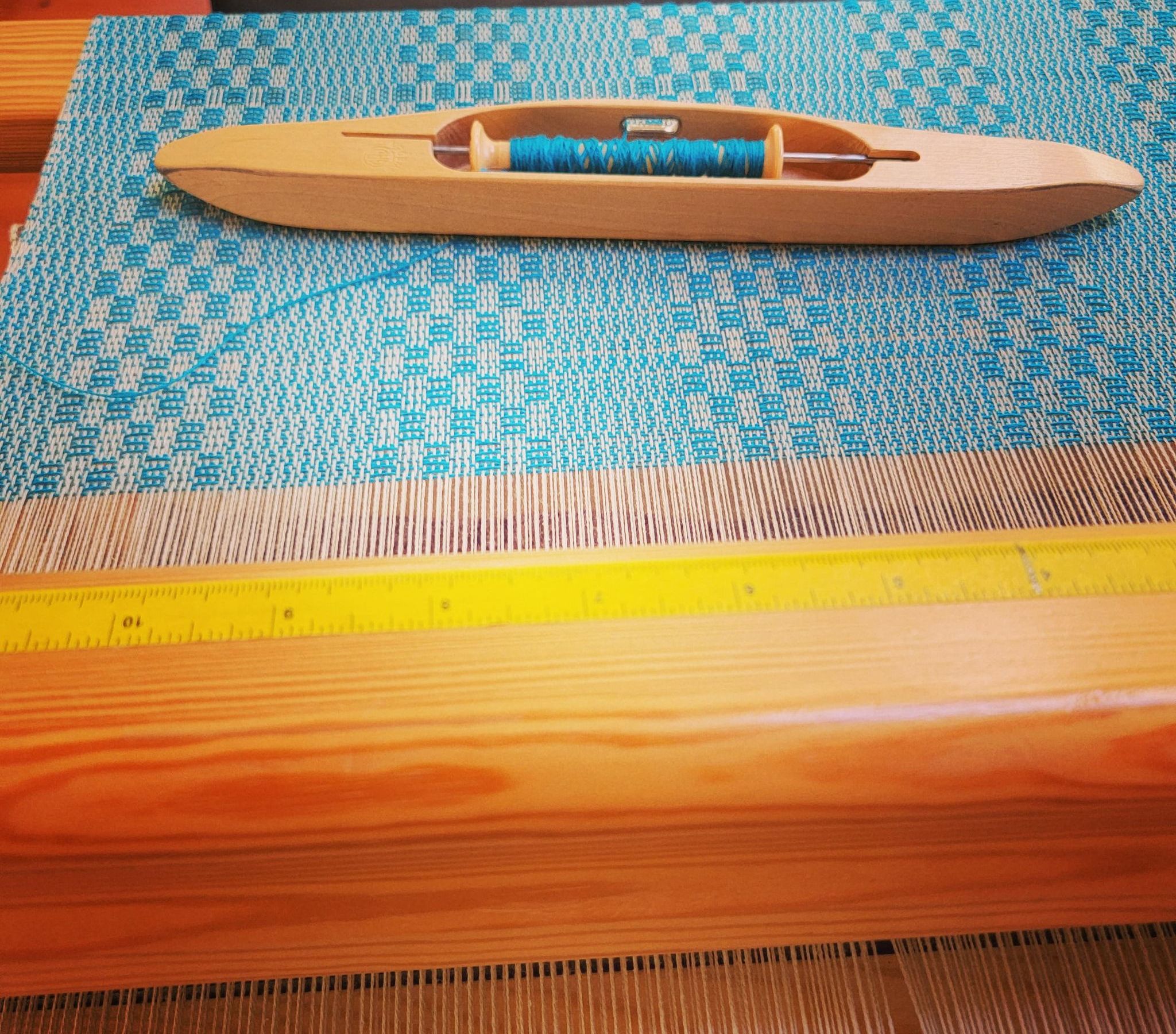
This morning I scared a racoon in the garden as I left the tiny zendo after-meditation. I wish I could have gotten a picture of it scampering away because it was undoubtedly the fattest raccoon I have ever seen. Compared to when we lived in East Vancouver, I don’t see raccoons here nearly as often, but springtime definitely brings them out into the open a bit more and I’ve heard them fighting on the other side of the fence some nights as well.
It’s been a week of trying to get things done despite intermittent insomnia. I can only blame the shift in weather and energy for my sudden inability to sleep through the night, so I hope that calms down again soon – because it’s very difficult to move forward on projects when I’m exhausted all the time.
Workwise things have been in a bit of a lull the last couple of weeks.. This is always the case when the fiscal year flips over and we do our project plans for the next year. Up until year end is a flurry of activity and then things get pretty quiet again while we wait for the budget to drop and new projects get approved. I’ve been focused on work planning, and performance management – and getting the two people on my team properly assigned with work now that I have them as permanent staff. I had my own performance review as well this week, and received the highest praise I have ever achieved in my working career, which stemmed from the huge shift in my work unit I’ve helped motivate over the last year, first as acting manager, then as supporter to the other acting manager. While I’m glad that our regular manager is back now, her year of absence did afford me some pretty great work opportunities. I’ll be interested to see the government priorities outlined in the upcoming budget, because that guides our work to some degree.
On the studio front, I’ve become re-obsessed with weaving in the last couple of weeks. As I’ve written here in the past, weaving is a time-consuming and somewhat complicated undertaking (not to mention, expensive). All fiber arts have dimensions of this, but weaving more than any of them. I think this is why I tend to drop out of it periodically. Only a month ago I was talking to Brian about possibly selling off all my weaving supplies since I had not been able to rouse my interest in weaving in close to a year. This last week I got a warp on and off the loom (to make four tea towels) in record time. I am starting a new project today (hand towels for the bathroom), and am re-tying up the treadles on the large loom (although I did manage to get it warped at Christmas time, I tried a new tie-up that it turned out I don’t like). The problem with weaving is that I’m hot/cold with it. When I’m hot, it’s all I want to do. When I’m cold, I want nothing to do with it. Few other of my interests work like this for me – and I can’t ascribe it to one season or another. It just happens when it does. Go figure that it would happen just when the weather is getting so nice!
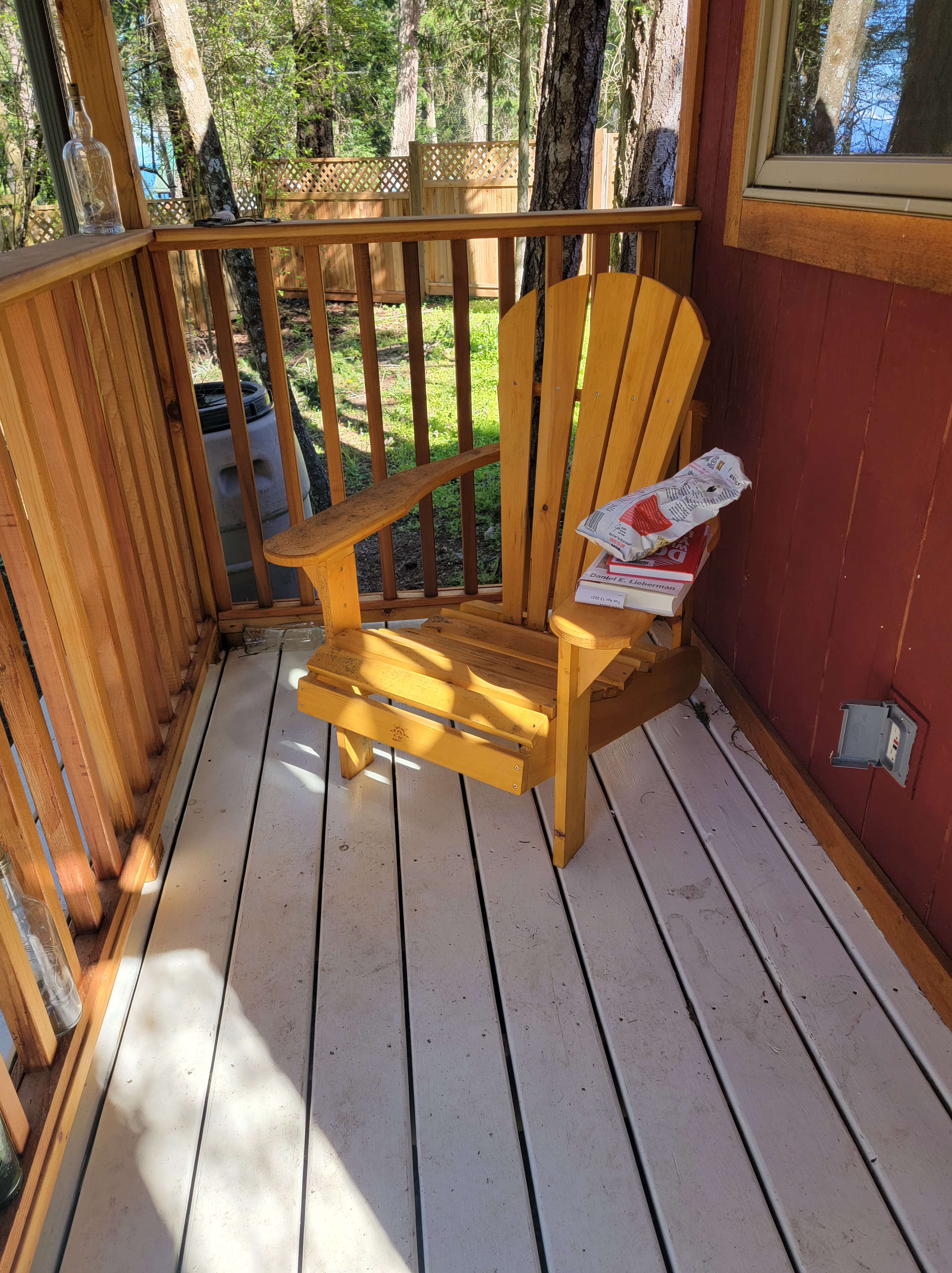
Around the house we’ve started working on our latest project – a canning kitchen! While I have long had an outdoor burner for canning in the summertime, we are going to go all the way and install a sink and counter alongside that. It will sit directly in front of our actual kitchen so we can share the plumbing going in, though we will greywater into the garden going out. To start with, we invested in a (kind of pricey) stainless steel sink and countertop which we will then get some cabinetry installed around. The three-burner will also get a cabinet front to hide the propane tank. Because this is at the (covered) entrance to our house, we are paying a professional to make cabinets. I want it to look good and not cluttered. We got the sink/counter last week so we popped things into rough place last weekend:
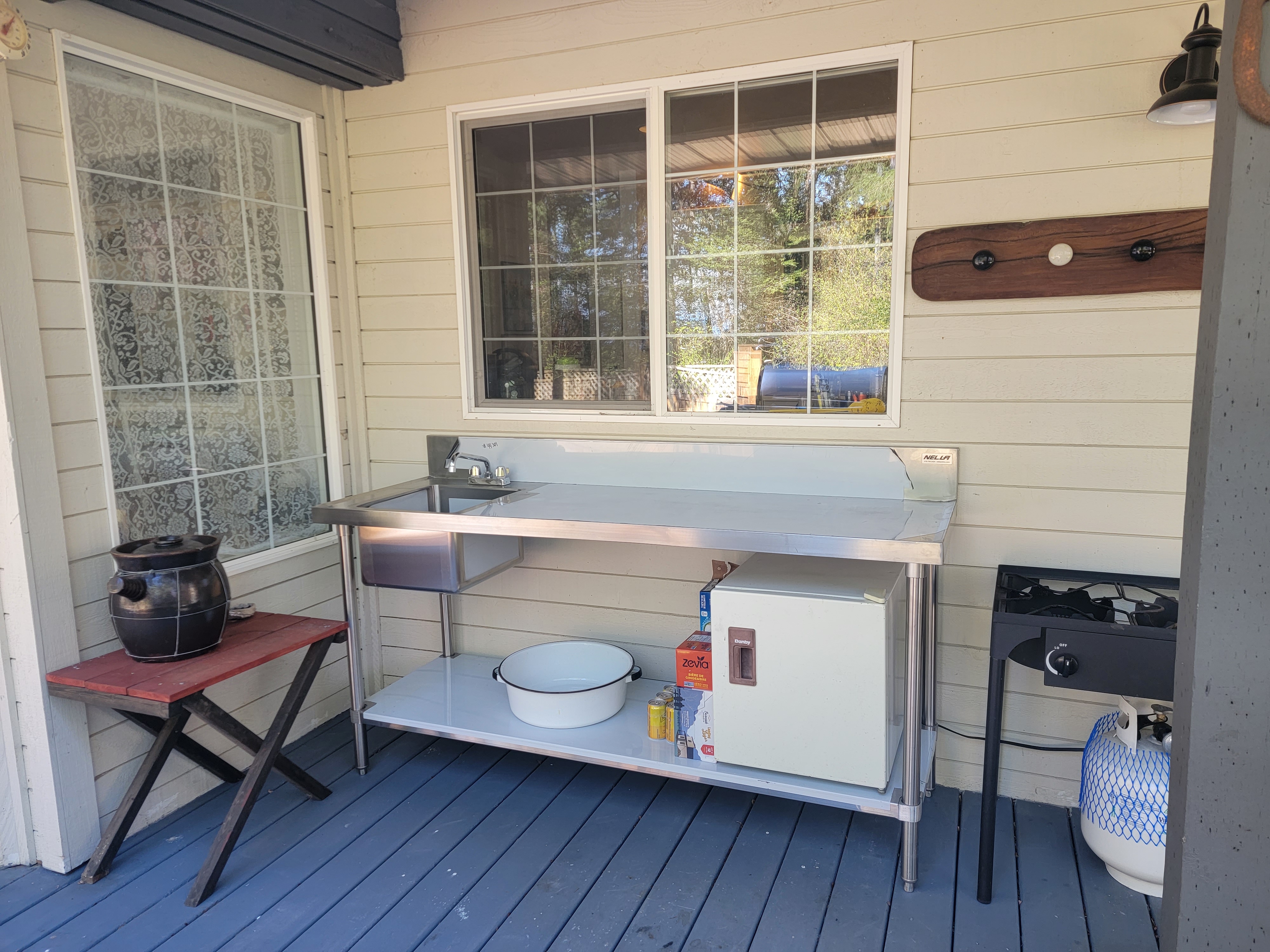
I know I’ve said this before, but the more we tool our home to be specifically for our needs/interests/comfort – the less likely it is that I am ever going to leave. A properly set-up area specifically for canning and outdoor entertaining is something I have dreamed about, and we are making it happen!
This is one of those weeks that has dragged a bit (insomnia) so I am pretty glad to nearly be seeing the weekend when I can catch up on my sleep and make some more headway in the garden and studio. Hope you all are seeing sunnier days out there!
Post #3229: Unexpected offerings
I dip in and out of the idea of getting published one day – by which I mean publication in a magazine or online periodical, or by a publishing house (as opposed to self-publishing ventures). It’s a bit of a block for me. Most of the content I write goes to Comfort for the Apocalypse and I have a hard time getting excited about writing content that is tailored or fits a particular demographic. At the same time it feels like publication is legitimizing, and elevates writing from being seen as a “hobby” to something else.
I am germinating a new idea for a possible book project which has brought this question to the fore again. Really, it’s the question of why I write at all. Is it to get published/be legitimized? Or is writing a way of figuring out what I think and connecting with others via those communicated thoughts?
If you read most online advice articles about writing a non-fiction book, the main recommendation is to write a powerful book proposal and get it in front of publishers. They say maybe you should write a chapter or two of the book, but the main thrust of the advice is to sell it as an idea first before investing too much time in the writing of it. This suggests of course, that one has a fully-formed idea of what they want to write before they do it, which is the exact opposite of me. I come up with a general idea and then write it out into an incoherent first draft, which I then edit it several times, asking myself a thousand questions about whether each word choice is what I really want to say, and then ending with a piece that is radically different than what I thought it would be. The idea of carefully writing a book proposal and then sticking to it is a bit unfathomable to me. Not to mention the idea of having to sell myself or my ideas to others.
Which comes back to the fact that writing, for me, is a way of figuring out what I think and then connecting with others, even if “others” is only a very small newsletter and blog readership. My day job means that I don’t have to monetize writing, which is probably a good thing because marketing me isn’t my strong suit. Perhaps writing isn’t my strong suit either, but it requires less effort (and that’s saying a lot because writing is no walk in the park).
This blog is my most personal place, and the place where I worry the least about my output. In keeping with that, and the fact I work my ideas out as I wrote, I’ve decided I’m going to start posting here more meaningfully again in order to experiment with some ideas and writing approaches (in addition to my Friday week-in-review blog posts which work for me on a different level).
When I first started Red-Cedar.ca 18 years ago, the whole purpose of it was to document the apocalyptic times we were living in then (hence the tag line “more apocalypse, less angst”), but it has been a place to document all sorts of other thoughts, life changes, and recipes as well. When we first moved to Gabriola, I tried a brief rebrand with a softer tag-line and more textile-focused content, which felt totally inauthentic to me and so I switched back to whatever it is that Red-Cedar.ca projects, and added CfA to the mix of outputs. Whether I post her regularly or don’t, Red-cedar.ca is the closest thing I have to a diary of the last eighteen years of my life and so it makes sense that as I continue to shape and build my writing (and music), I would do more of that here.
Post #3228: Letting things go

I’ve been having a lot of mask-related dreams in the last few weeks where I am in a public space and either I am not wearing a mask and everyone else is, or I am wearing a mask and everyone else is not. At first I thought these were like test dreams – where you go to take a test and can’t find the room, aren’t wearing pants, have forgotten everything – which are always coded as dreams about anxiety. I thought the mask dreams were similar because anxious distress hallmarked my interactions in those dreams. But this week I’ve come to understand them as dreams about not being in proper relation to others. My distress is about the mismatch between my state and the state of others, my relationality, and it is this that provokes the anxiety. As a dream-message this makes a lot more sense to me given where we are at in the pandemic. By now, I had hoped to be in greater relationship with others again, but instead we are in a deadlier third wave and still waiting for vaccination. No wonder my subconscious is telling me that I’m not relating as I “should”.
One thing I have been working steadily on all week is getting my loom warped. I started this project two weeks ago but something went really wrong in the warping process and I had to scrap my first attempt. I finished threading this second attempt and got it all wound onto the beam on Wednesday night. This morning I threw a few shots in it to make sure it was set up correctly and voila! It might be the best warp I’ve every put on in terms of a clean shed:

This fabric will be used to make four kitchen towels of different colours. It’s not a very exciting pattern, but I wanted something simple to put on and weave off the loom for a quick set of dish towels (two of my old ones got holes recently). I frequently envision and try to execute really grand projects, but the truth is that simple is better and more do-able given all my other projects and work commitments on the go. For this weave, I took four shafts off my (eight-shaft) loom to make the whole enterprise easier and am I ever glad I did. Note to self: when I cut corners by leaving empty shafts and lamms tied up, it actually makes everything more difficult and time-consuming.
In addition to getting the loom warped, I also finished sewing a dress/tunic on Monday though I have no photos to prove it yet.
I found out this week that there is nothing wrong with leg that swelled up a couple of weeks ago. The metal plate hasn’t shifted, the bone healed fine underneath it 18 years ago, and there is no deterioration of the bone. The doctor thought it had just been aggravated somehow but told me that unless it continues to swell up, there is nothing to worry about. That’s good news for sure, but I find myself asking if I want to return to running even now that I know the striking impact isn’t harming me in any way. One of the ways that I’ve coped with the pandemic is by getting a bit exercise-obsessed, adding running to an already full schedule of weight lifting, yoga and walking. After taking a week off from everything when I got the swelling, I realized that all the activity is really crowding out other things, including my ability to sit/be quiet/think. I don’t want to give up the weight lifting which has measurably changed my life, and walking is pretty social for me. Yoga is intermittent/non-obsessive. But running, quite frankly, feels like a lot of work for little additional benefit. Perhaps as nicer weather rolls around I will find it calling to me again, but for now I’m happy for a bit more time to do other things than exercise.
In carrying on with the theme of giving things up, I am well on my way to my 2-year retirement plan from my union position and have successfully referred several union matters to my new shop stewards in the last couple of weeks. Every time I *don’t* take something new on, I feel a little relief run through me. While I still have to help the new reps with their grievances, responses to inquiries and so on, just the fact that I don’t have to interface with upset people every day feels like a huge weight lifted off of me. It’s also making me aware of just how much stuff I was fielding in the first place as I try to ensure that I don’t overload anyone (for the last couple of years, there have literally been two of us taking every case – now I have several people on board to distribute the work to).
On the Birdsong Gabriola front, I finally got the domain fixed on the new website so I can share birdsongisland.ca with you. Yesterday I confirmed out summer line-up of local musicians for a yard concert series starting at the end of June – which isn’t on the website yet but will be by the end of the month. Just the other day, Brian and I were out in the yard and a woman I’ve never seen before pulled her car up and got out to ask if we could put her on the email list for the house concerts – so clearly I’m not the only one in need of some social music time these days! I am quite hopeful that outdoor shows in mid-summer with vaccinated people will be allowed, making this a little bright spot to look forward to.
The BC pandemic numbers may be high, but at least it’s Friday and we have some sun on the horizon for the next several days. If you subscribe to Comfort for the Apocalypse you’ll be hearing from me on Sunday – but otherwise I’ve got few plans for the weekend coming other than writing, weaving, and playing some music. Hope you are all well out there in quaran-land.


 Red Cedar