Red Cedar
More apocalypse, less angst
Best burger evaaaah…..
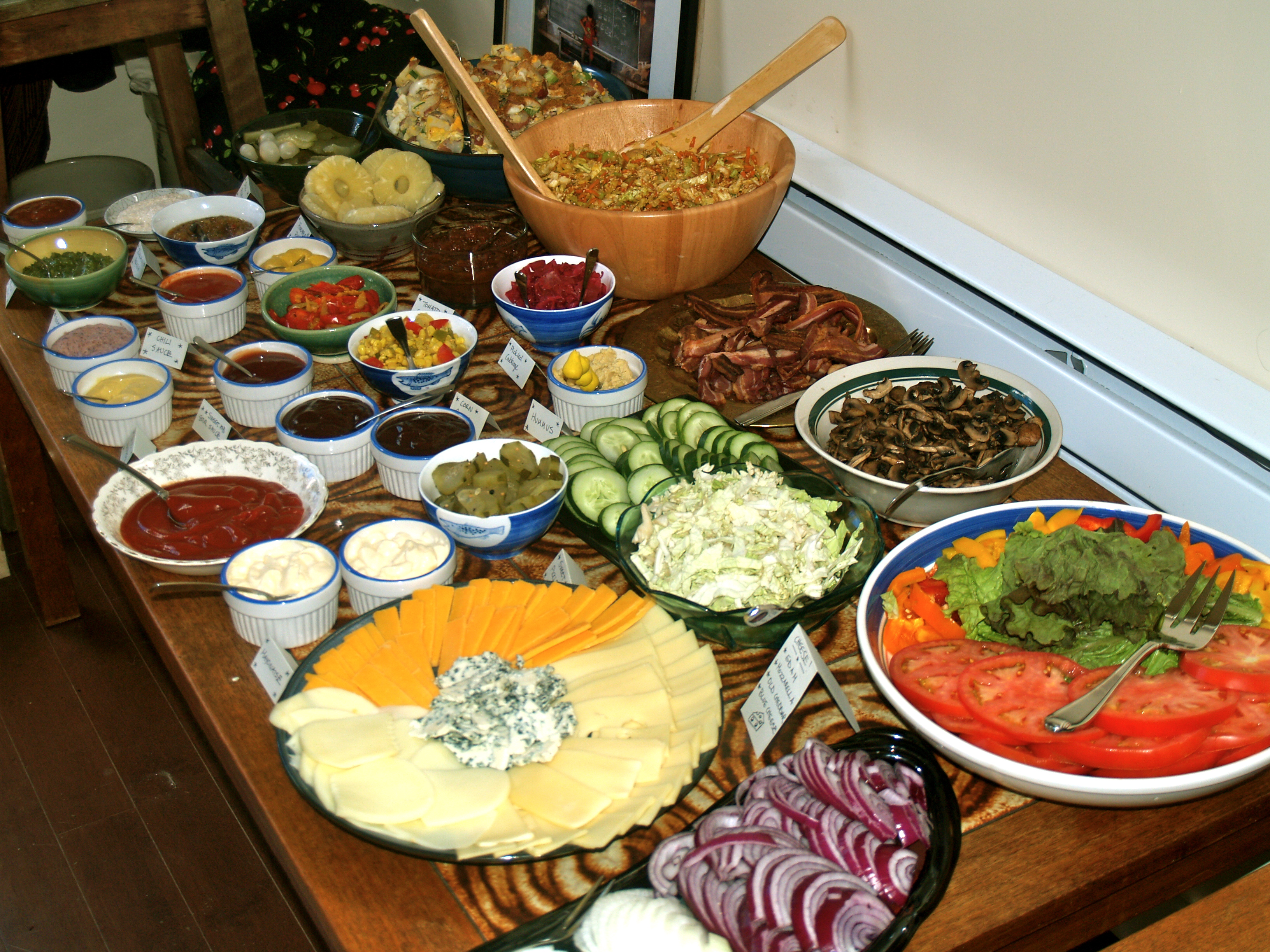
Every once and awhile I get a really good idea – and recently that happened to be about the food theme for a party we hosted at our house this weekend. Our friend Dave turned 40! this week, and so we offered up our place and an idea for the food: “Best Burger Ever,” which turned into a massive condiment bar for either meat or veggie patties. Marika (Dave’s partner), Brian, and I basically pulled it all together on Saturday morning.
It was so incredible I just had to take photos and document exactly what was on that burger bar:
- Kaiser and whole wheat buns
- Four kinds of cheese: Swiss, Cheddar, Mozza and Blue
- Two kinds of onions
- Tomatoes, bell peppers, lettuce
- Mushrooms
- Cucumber
- Green cabbage
- Bacon
- Pineapple rings
- Hot peppers
- Dill pickles and Sweet pickles
- Horseradish
- Hot chilli sauce
- Three kinds of relish: green, zucchini & corn
- Ketchup
- Two kinds of mustard: regular yellow and dijon
- Mayo
- BBQ sauce
- Mayo
- Sweet and Sour Sauce
- Red Bean Pesto
- Hummus
- Pickled cabbage
- Tomato Chutney
Not only was this a relatively simple way to feed a lot of people over the course of an afternoon and an evening – but it wasn’t crazily expensive either – particularly as many of the condiments came out of our canning and veggies from the garden. (In addition to all this we put out potato salad and a non-mayo coleslaw) plus snackity things. Best of all? Several people through the course of the evening said: “This is the best burger ever!” And really, it’s all about that kind of exuberance isn’t it?
This is definitely a food theme I would do again: it’s visually impressive, self-actioning (people can throw a burger on the grill anytime they feel like it), provokes discussion and debate about appropriate burger condiments (several people ended up promoting the sweet-and-sour burger), and it’s easy to do veggie and meat options for a diverse crowd.
!Plus! my zucchini cake decorated with calendula and marigolds went over pretty well too:
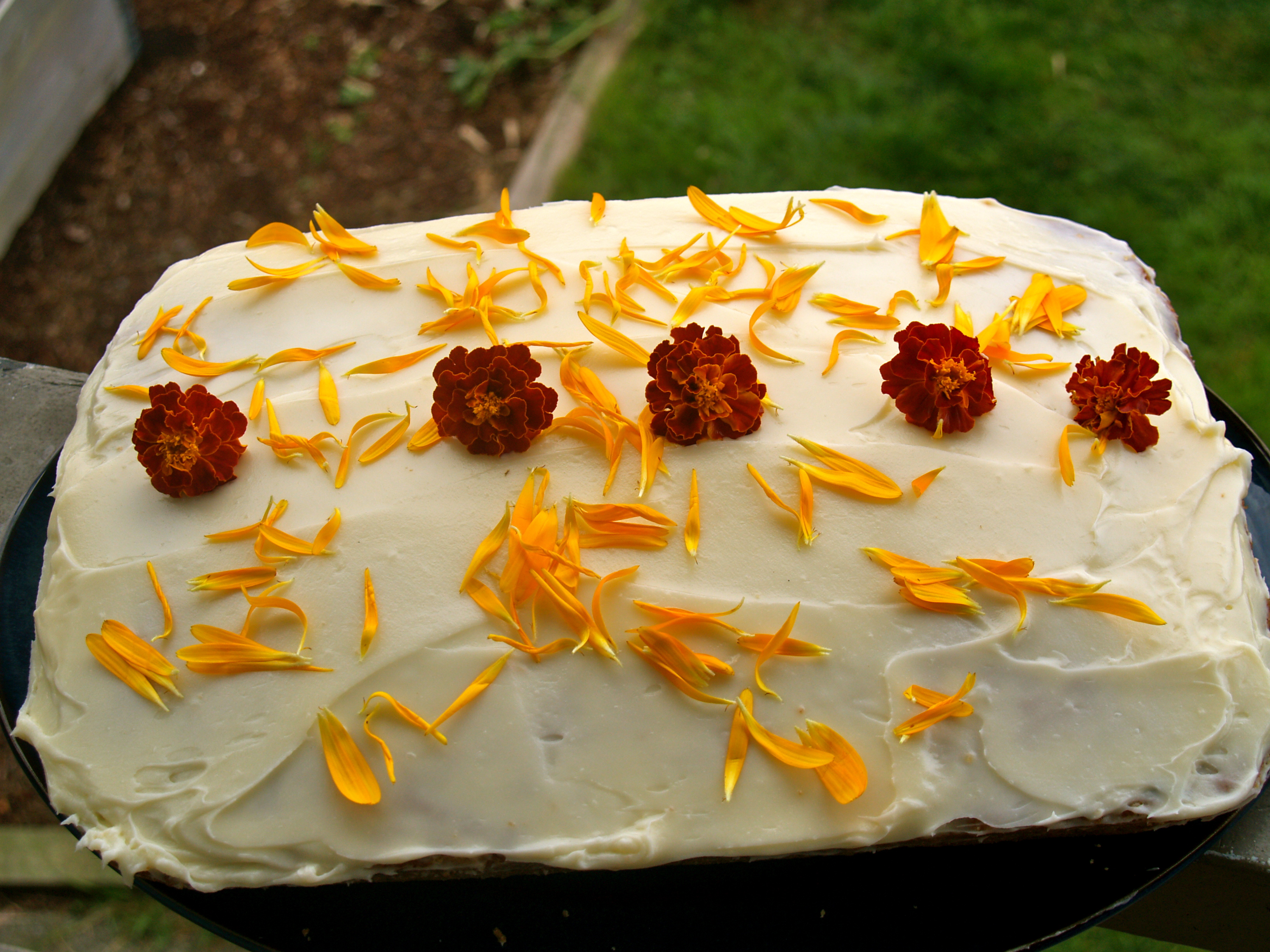
Sadly, that was probably our last outdoor party for awhile – we strung up a tarp to hold off the rain but if it wasn’t for the late-night hot-tub action everyone would have been pretty cold. I guess it’s dinner-party time again.
Not clad in diaphanous garments, nor shod in dainty slippers

I will have naught to do whether with lover or husband
Albeit he comes to me with strength and passion
I will live at home in perfect chastity
Beautifully dressed and wearing a saffron-coloured gown
To this end I may inspire my husband with the most ardent longings
Never will I give myself voluntarily
And if he has me by force
I will be as cold as ice and never stir a limb
I will not aid him in any way
Nor will I crouch like carven lions on a knife handle
And if I keep my oath, may I be suffered to drink of this wine
But if I break it, let my bowl be filled with water.
[The oath of Lysistrata and female company in Ancient Greece – taken to persuade their menfolk to stop making war with each other. ]
Lysistrata is the only Greek comedy we are reading this semester, a light-hearted look at social relations in Ancient Greece that is as revealing as the tragedies – and certainly as provocative. Although the only authentic female voice from this era to have survived the violence of history is Sappho’s, we have to believe the representation of women in the works of male writers is to be taken as believable to audiences of the day even though we must surmise in Lysistrata that characteristics of both sexes were exaggerated for comedic effect.
If we pursue the text this way then what I found most interesting about Lysistrata is the portrayal of women in Ancient Greece as:
- Interested in the sensual despite the daily chores of their lives.
- Disdainful of the prevailing image of women as dainty, lounging creatures.
- Essential to the running of the household, and the care for children.
- Powerful within their own domain, though excluded from public discourse and shunned from decision-making outside the home.
- Body-focused and interested in the physical form as was the norm for men in Ancient Greece.
- Important economically to their households – there is continual reference to the activity of carding wool which would have been done to create textiles for household and market.
- Financially capable.
- Grudgingly accepting of violence against women as a given.
- Totally accepting of the distinction between freeborn and slave women and willing to differentiate in quality of feeling depending on which group one was in.
- As sexually needy as men.
[Although the play provides scenes between the male and female choruses in which the women beat the men and humiliate them publicly, it is hard to imagine that in a society where women were so totally excluded from power outside the home and market this would have stood.]
Lysistrata is also an interesting reversal of gender norms seen in other Greek plays (particularly tragedies) where women are the representation of more passionate impulses against the rational men who hold guard on tradition and “truth”. Although women are represented unevenly in this play, the key female figures (Lysistrata, Mhyrrhine, Calonice) agree to what is an entirely reasoned approach to ending the war in Greece – that is exerting power within the sphere that they do control. It is the men in this play who are cast as somewhat pathetic, railing against that which they can not change – generally puffing themselves up – and ultimately unable to contain their desire. By the end of the play, the men desire their wives who refuse them so greatly that they are doubled over with erections and barely able to walk.
Unable to walk, they are unable to fight and thus bring in Lysistrata to broker the peace – which is the only reasonable thing to do given the disruption years of war have wreaked on the society. Is Aristophanes – who wrote this during the war – making the argument that because men are responsible for such foolishness, the old paradigms are subverted and only women can be trusted to lay passion aside to end the war?
For a modern-day version of the same story (with impeccable timing I might add) – see the following video about women in the Philippines who recently staged a sex strike in their village in order to end a civil conflict that was impeding their ability to bring their textile goods to market:
**************************************************************
Post-class discussion notes:
On more reflection about the actions of Lysistrata and her country-women, not to mention the above YouTube piece – it occurs to me that the sex strike is only a possible weapon because of women’s economic centrality in their society. Not only are the women in Lysistrata disrupting the bedroom, but the fact they are not in the home would be profoundly disruptive to the economics of Greek society. As noted in my earlier reflections, there are repeated mentions of the carding of wool in the text which suggests to the audience the actual importance of women’s work in bringing money into the home. Additionally it was raised in discussion that women in this role would have been responsible for running every aspect of their households and also the fields in their family possession. To remove themselves in the way suggested in the play is amusing on the surface, but represented a real threat to smooth functioning of ancient Athens.
Interestingly, the person who introduced the text in class argued Aristophanes as conservative (in contrast to a more progressive Euripides) – as the entire objective of the play is to get women back into their place by the end, and in fact when their demands are met, the women return to their homes. But to accept this analysis, I would also have to accept that women in Ancient Athens were akin to slaves and were *only* oppressed by their existence… that to willingly re-enter their homes was a step backward. That, I’m afraid, is a little too much looking through our own modern lens to prescribe motive. While it’s true that women did not have the same rights or access as men in their society, it is equally true that they did exercise power and influence in their own spheres that would have provided real satisfaction in their contributions. This marks the middle-class women of ancient Athens as profoundly different from their Victorian counterparts 2000 years later – women who had little to do, controlled by their male relations, and so suffered the oppression of boredom. We can not overlay gender analysis without also understanding that in each specific era the oppression of women would be understood differently from the subject perspective. That is, women have not always understood their position as oppressed in the way that we currently might view it. We also need to recognize that humans are inherently conservative in the preservation of their social order – thus the return to the familial home by all in the end – which is a fact that even a more progressive playwright would have to observe for a story to be accepted by the audience as realistic.
And to that, which would be a more progressive ending in real terms? In Lysistrata the women exercise power by making their private sphere public business and achieve their objective allowing them to return to the regular rhythm of family life. To instead go on from there in a greater social revolution of changed gender roles would imply more upheaval which is exactly what the women in Lysistrata are attempting to avoid. They are exhausted from warfare (as was Aristophanes by the sounds of it), and they do what they can to extract their communities from it. It’s hard to imagine that a continuance of conflict would be desired by anyone at the point of resolution.
Laundry, love and the lyre (Sappho 2)
(Above video an example of the ancient Greek Lyre – in the style that Sappho would most likely have played).
Of all the things I’ve read so far, Sappho was the writer who drove me immediately from reading into writing down my impressions of her poems – so vividly was I moved by her imagery and her emotional eroticism. In class Wednesday, I found myself experiencing a similar immediacy with the work as we entered discussion – and again in awe that although 2600 years stands between us – our emotional resonance travels on similar frequencies. Not that I am living in a world of being denied who I want and pleasurably tormented with it – as is obviously the case in Sappho’s life. But that our jealousies and wants – passions – manifest so viscerally (a thin flame runs under my skin, my eyes go blind, my ears ring). As though our physical life is merely an extension of our feelings rather than the other way around.
Her love-making is idealized in her lyrics – full of flowers, expensive oils and soft skin/linens/pillows – which seem to make up somewhat for the heartwrench she experiences in her continuous cycles of loss (so continuous that Aphrodite asks what is it this time? in the only full poem of Sappho’s that exists). Each transcendent love-making experience apparently cut short by jealousy or loss – it seems that Sappho is seeking the divine in her communion with those in her life (women? men? both?), but can only have an imagined friendship with the gods.
I do not expect my fingers
to graze the sky
she says in recognition of her mortality – her physical body keeping her in both torment and delight. Does she really wish to abandon her human form? Her delight is clearly there, for Sappho’s life is full of sensual pleasures – elaborately-dyed sandals, textiles, the natural world, incenses and sweet nectars – she is at home in her senses which are rendered beautifully. For all the pathos in some of her self-deprecating comments, the reader gets a sense of the intact sphere in which Sappho lives. A world of laundry, love and the lyre – all sung about with grace and good humour. We do not feel sorry for Sappho in her lost loves so much as we empathize – a forerunner of our best female friend, the woman who bares all.
Love in the time of Socrates
(My pre and post-class notes on The Symposium).
Long before I had ever heard of the Symposium, a reading of Voltaire made me aware of the speech of Aristophanes which occurs about halfway through the text. Immortalized in many media forms (not the least of which is Hedwig’s heart-rending version above), it is a story that resonates with me. Not only is the idea that we are searching for our other half familiar (cliche yet somewhat comforting nonetheless), but I’ve always appreciated a myth that makes room for the diversity of loves which might exist (between men, between women, between those of opposite sexes). Although it’s not the pinnacle to which we can experience love (as Socrates points out in his throw-down), this speech is one which has a high degree of emotional resonance to readers of The Symposium.
Told in a humorous form, this speech is anything but comic in its tale of punishment and subsequent yearning, and reminds us of the loneliness we might feel when in the world solo – as well as the sense of recognition that exists in our “match” when we meet them (not to mention that desperate staying up all night talking that happens in the beginning as though we are trying to fill our other halves in on everything that has happened in their absence).
Love is the name for desire and the pursuit of wholeness…. If we are friends of the gods and have him on our side, we shall do what few people now do — find and become close to the loved ones who are really our own.
++++++++++++++++++++++++++++++++++++++++++++++++++++
But of course, the speech of Aristophanes isn’t exactly the point of The Symposium – though it may be the point at which many of us find ourselves in our navel-gazing about love (navels being a product of Zeus’s punishment). Rather, it is the super-hero Socrates (who never gets tired or drunk or falls in human-like love or is dirty or makes a wrong argument – and is also the best soldier, the toughest man and the most admired of all) who draws the debate to its crescendo.
Desire and love are directed at what you don’t have, what isn’t there, and what you need.
And more to the point, says Socrates, love of bodies and love of individuals are only a pathway (a paltry one at that) to realizing perfect forms, and perfect beauty in a state of enlightened purpose. He recounts the teachings of Diotima:
Instead of this low and small-minded slavery [love of a particular person], he will be turned towards the great sea of beauty and gazing on it he’ll give birth, through a boundless love of knowledge, to many beautiful discourses and ideas. At last, when he has been developed and strengthened in this way he catches type of one special type of knowledge…… Like someone using a staircase, he should go from one to two, and from two to all beautiful bodies, and from beautiful bodies to beautiful practices, and from practices to beautiful forms of learning. From forms of learning, he should end up at that form of learning which is of nothing other than that beauty itself, so that he can complete the process of learning what beauty really is.
Love, then being the purpose of all living. A portal from the (base) physical, through the tender emotional search for our other half, toward becoming a friend of God – immortal in being if not in body. Trust Socrates to get to the real truth! And this is obviously where he believes it lies – in divine communion.
But! For all of that noble talk, in walks Alicibiades – as if to show us all the ways love masquerades in the mortal and vain humans who populate the world. Alcibiades immediately begins poking at Socrates for turning down his advances, stirs up jealousies and promotes heavier drinking. For all the learning of the men in the room, the rapid drinking that follows devolves their previously restrained dialogues into childish and pettty name-calling. Even Socrates gets catty! After such a lofty speech, this closing episode seems to indicate that while we might understand love as a road to the divine – most humans are a long way off from communing with the Gods.
Zucchini-craze.

The summer squashes are endless at the moment – I’ve got zucchini, ronde de nice and yellow pattypan all producing voluminously in my early-autumn backyard. What to do with them all?
Well tonight we had ronde de nice squash stuffed with ground beef, tomato and onion (topped with cheese), and earlier today I made a big pot of zucchini puree which is freezable and makes a great nutritional addition to winter soups and stews.
But by far my favourite recipe this year has been this carrot-cake-like dream adapted for less sugar from All-Recipes.com:
Zucchini Cake with Cream-Cheese Frosting
- 3 cups all-purpose flour
- 2 cups white sugar
- 1 teaspoon salt
- 1 1/2 teaspoons baking soda
- 1 teaspoon baking powder
- 2 1/2 teaspoons ground cinnamon
- 1 teaspoon vanilla extract
- 4 eggs
- 1 1/2 cups vegetable oil
- 3 cups grated zucchini
- 1 (8 ounce) package cream cheese
- 1/2 cup butter
- 1.25 cups confectioners’ sugar
- 2 teaspoons orange juice or orange extract
- Preheat oven to 325 degrees F (165 degrees C). Lightly grease and flour a 9×13 cake pan.
- In a medium size bowl combine the flour, baking soda, baking powder, cinnamon, white sugar, and salt. Mix well.
- In another bowl beat eggs, vegetable oil, and 1 teaspoon vanilla together. Pour into egg mixture into the flour mixture and mix well. Stir in the shredded zucchini. Pour batter into the prepared pan.
- Bake at 325 degrees F (165 degrees C) for 60-80 minutes (this cake needs a lot of baking time due to the amount of moisture – check it periodically after 60 minutes).
- To Make Frosting: Cream together the cream cheese, butter or margarine. Add the confectioner’s sugar, a little at a time. Add 2 teaspoons extract and mix well. Spread on cool cake.


 Red Cedar