Red Cedar
More apocalypse, less angst
Post #3237: On and off the Loom

As might be evident from the photos on here lately, my love of weaving has been rekindled in the last few weeks. At the outset of the pandemic, I sold my large loom because it wasn’t working for me on a number of levels. I still had my small Julia loom, but something about the sale put me into a bit of a weaving slump while I focused on sewing and other things. In the September I bought a new-to-me loom which I thought would spur my interest again (I love this loom so much), but even then I only managed to get one warp on it before drifting off again into other projects. The longer I stayed away, the more daunting it seemed to get a warp on either loom and about two months ago I told Brian that I was thinking of selling off all my weaving equipment and fiber. It takes up so much room that to leave it unused seems like a massive waste of space and energy.
Fortunately, he reminded me that I’m like this with things.
That is, I tend to swing between obsession and fallow periods in all creative endeavours. I run hot and cold, keenly focused in one minute, dropping my tools in the next. I’m not sure where this comes from, for it surely is not the way I was raised – with a focus on daily practice and incremental mastery in music – slow and steady, constant. The way I am as an adult is not that, though I know how to engage in daily practice and turn my attention on, I have a hard time disciplining myself to do so over long periods of time. On the upside, when I am productive in one area, I am *really* productive. On the downside, leaving skills to the side for months on end means that I lose a lot of ability in the offtime. This is especially true for things which require daily practice to maintain skill at – like playing the violin or writing.
One of the reasons I started Comfort for the Apocalypse at the encouragement of my friend Jill, was to give myself a monthly output and reason to write. Likewise, the times I have been most consistent in music practice is when I have been in a band, with regular gigs. Having an audience goes a long way towards encouraging my discipline, otherwise I tend to wander between projects without getting a lot “finished”. While that might look impressive on Instagram (process shots are exciting), the end result is a bit of a cluttered studio. I pretty much always have several unfinished projects kicking around, no matter how much I try to force myself to focus on getting them done.
Something that does help me finish weaving and sewing projects, is earmarking them as gifts from the outset. Lately I’ve felt a real call to give things away, which I expect is linked to the fact we are still in quarantine and it’s one of the ways I can reach out to folks I care about. When I think of all the people I would like to give some handweaving to, the list is endless! That gives me a lot of motivation to start and finish projects, and because handweaving is pretty rare in this world, the gifts are always well received. The issue then becomes that the obsessive weaving pushes everything else out of the way and I drop the writing, the music practice and so on. It feels like I’m always trying to re-balance my interests against work and other “hard” commitments that I don’t have a choice about showing up for.
I’m trying to work with the mindset that everything has its time and place, rather than getting stressed out about everything I (want to and) can’t fit in. Though I’m not sure why weaving has crept up as *the only thing I want to do all the time right now*, I have to appreciate my single-mindedness for the fact that I am advancing in my craft with every warp I put on and weave off the loom. As long as I can still fit in a bit of writing, and a few music practices a week, I don’t want to be too hard on myself. It’s not like anyone is waiting for my output (woven, musical, written, or otherwise) except me.
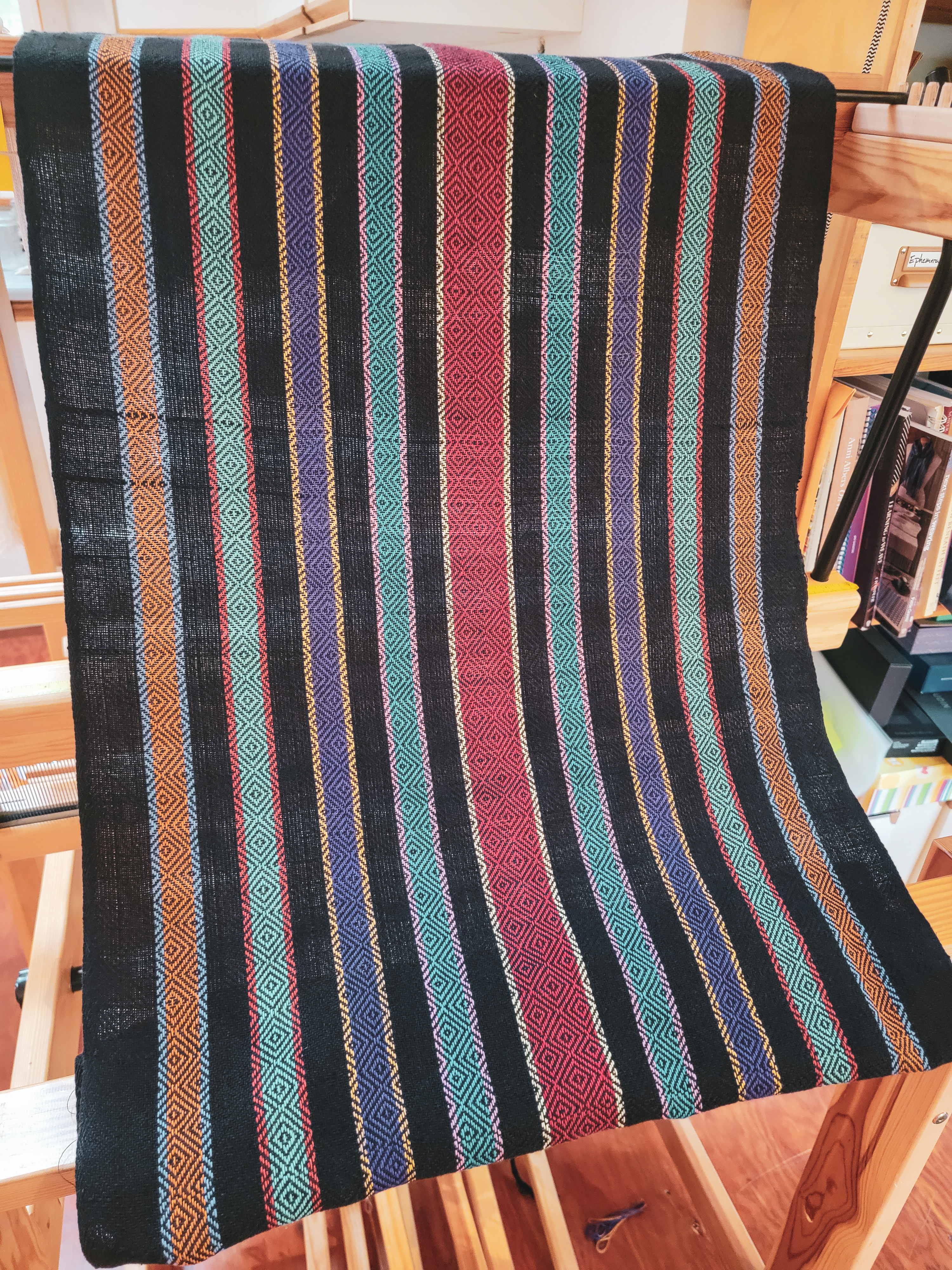
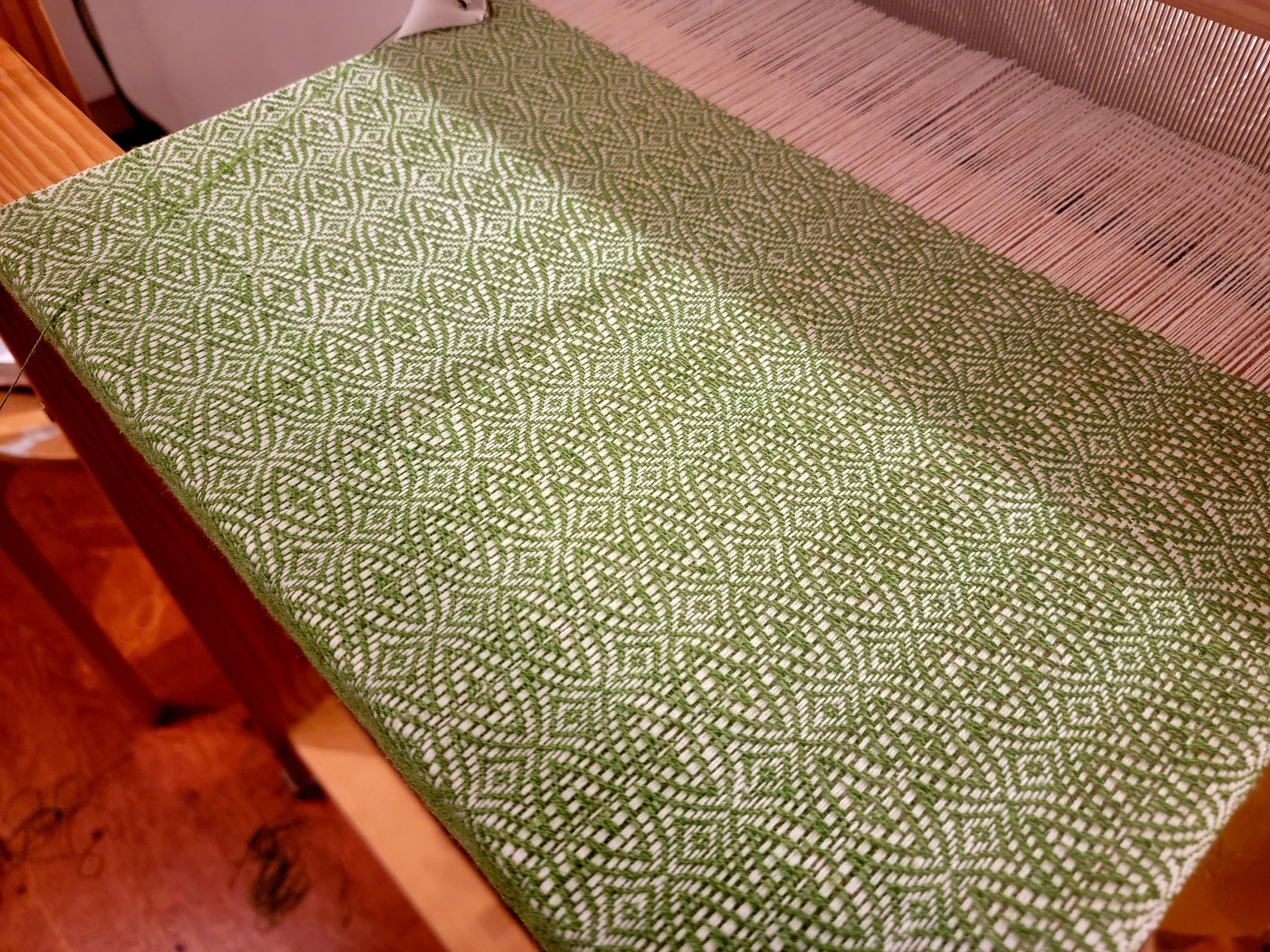
I have just restocked my weaving supply (see the above picture) for many more projects on the near horizon. I hope I can keep up this obsessive streak long enough to use at least half of that – but even if I don’t, yarn keeps and I always get around to it in good time. Yesterday I finished a table runner for a friend (fabric pictured here), and in the next couple of days I’ll be putting a sample on for some linen napkins I’d like to make for our house. I’ll think of it as a gift to our guests, and that way they might actually get finished.
Post #3236: Forms of work and play
This week has been all over the place in terms of time and routine. A bit of time off, some (more) dental appointments, and then full days of online union convention yesterday, today and tomorrow. While I am glad I took a day and half off at the beginning of the week, the rest of the changed schedule reminds me just how much of a creature of habit I am. I’ve been eating at weird times and working out in the morning instead of the afternoons. I’ve been having difficulty finding the energy to write and play music in the last couple of days especially.
And yet, it’s been a fairly productive week all round. I did manage to record three violin tracks on Saturday and Sunday for my husband Brian’s new album, and listening back to them, I feel pretty good about what I did – both in terms of how I divided the recordings up for a more professional approach, and also the parts I picked out to go with the tracks already laid down. I have been playing my violin steadily now since December, 3 or 4 times per week, the longest run of regular practice I have had in fifteen years.
I had almost forgotten what it’s like to play freely, without hesitation and stiffness – but it’s coming back to me now as my joints become more fluid and the instrument more of an extension of my feeling-self again. I’m not sure I will ever get back the dexterity I had when younger, but can tell you that the nascent arthritis in my hands has completely disappeared since January. At the very least, playing will keep my hands flexible longer. Sometimes the issue with dexterity isn’t so much the joints themselves, but the connection between my brain and body, and that’s something I know has gotten slower with age. The muscle memory doesn’t lock in quite as quickly as it once did.
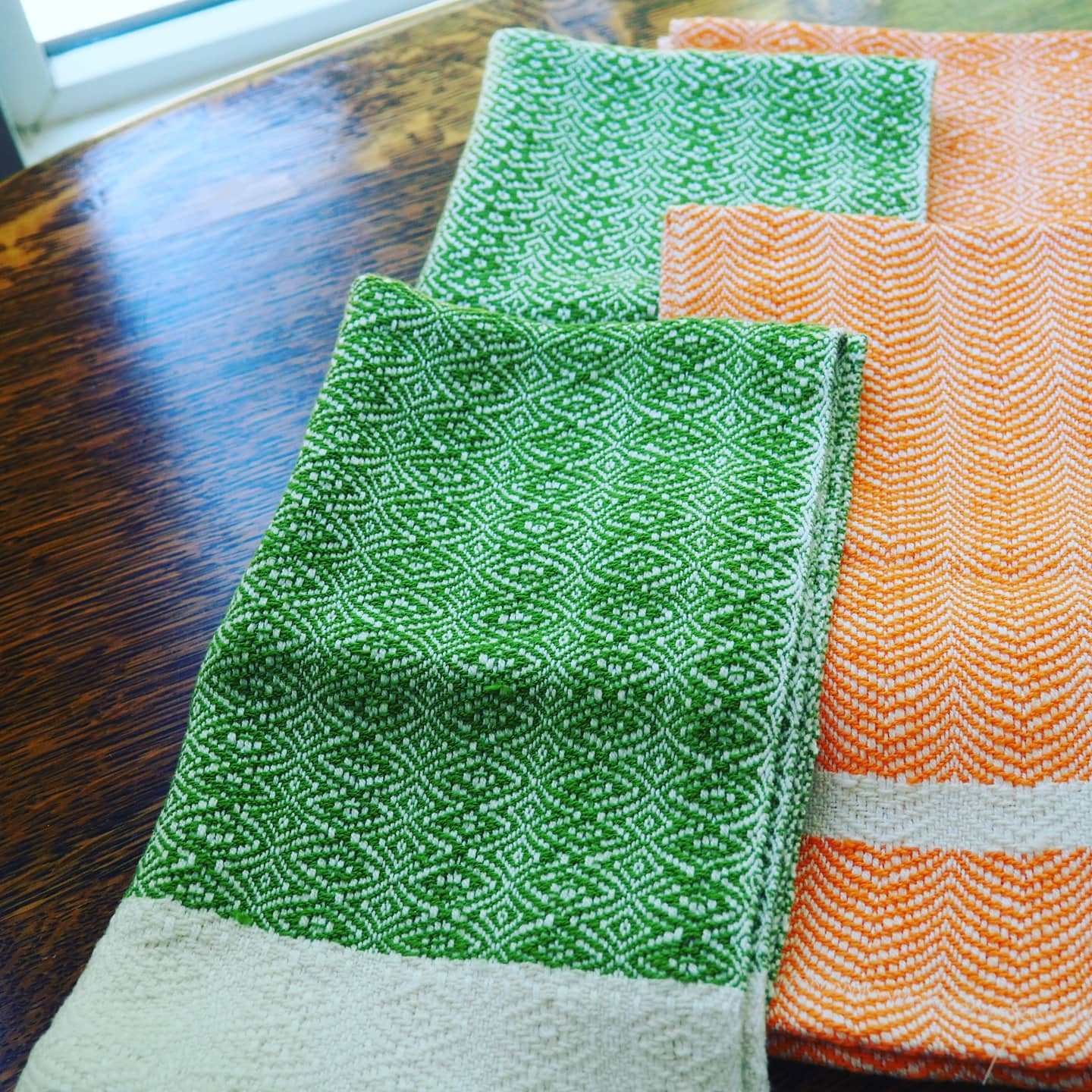
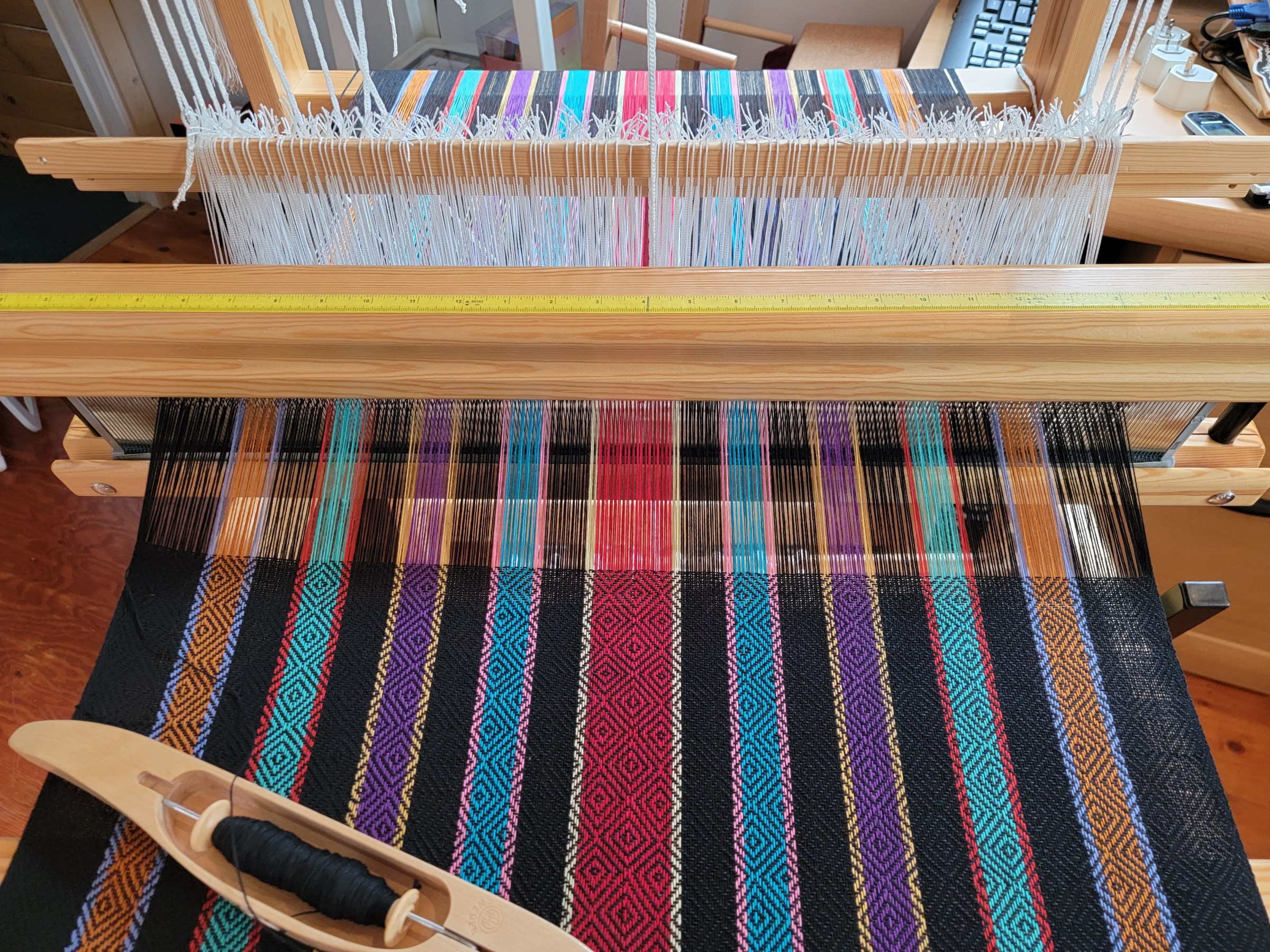
Besides that productivity, I finished weaving and hemming the hand towels that were on the loom last week, and warped again with what I think will be a table runner (pictured at the top). Having Monday and Tuesday morning off work really put a dent in a number of small projects around the studio, and I even got started on a bit of sewing for the first time in awhile. Studio time has been mostly flow-state lately, with one project morphing into the next, and tidying going on simultaneously so that things really keep moving. I wish it was always so easy!
I’m looking forward to my next projects which include experiments in weaving linen, some more tea towel gifts, getting the big loom up and running with shawls (treadle cords retied and we’re a go), and an overshot project in silk.
I think I mentioned a couple of weeks ago that I’ve returned to running – just a couple of times per week, but I’m enjoying the bit I’ve been fitting in. I’ve also made some new fitness goals for the spring/summer – to push my power-lifts up in density, to get additional outdoor activity in every week, and to stretch for at least five minutes aftder every strength workout. My strength training the last couple of weeks has been fairly intense, but I am very satisfied to complete the workouts. Ever since I started doing Stronger by the Day about five months ago, I’ve really noticed big differences in my body composition. I look the same to folks on the outside, but my muscles are much more present and defined. I find it hard to show this stuff off because I’m not much of a muscle-flexer, but its real and I can link my growth in muscle over the last eighteen months to better posture, better metabolic rate, and more stamina overall. I just finished reading the book Exercised by David Lieberman and it was one of the best books I’ve read about why we resist exercise (evolution, obviously), but what it does for us – especially as we age. It’s some of the best work I’ve read about fitness and evolution, science-based and not at all faddish.
Union convention continues through the weekend so I am definitely tied to my desk when I’m not playing for the next few days – but then next week is back to my regularly scheduled life.
Post #3235: Spoon by Emily
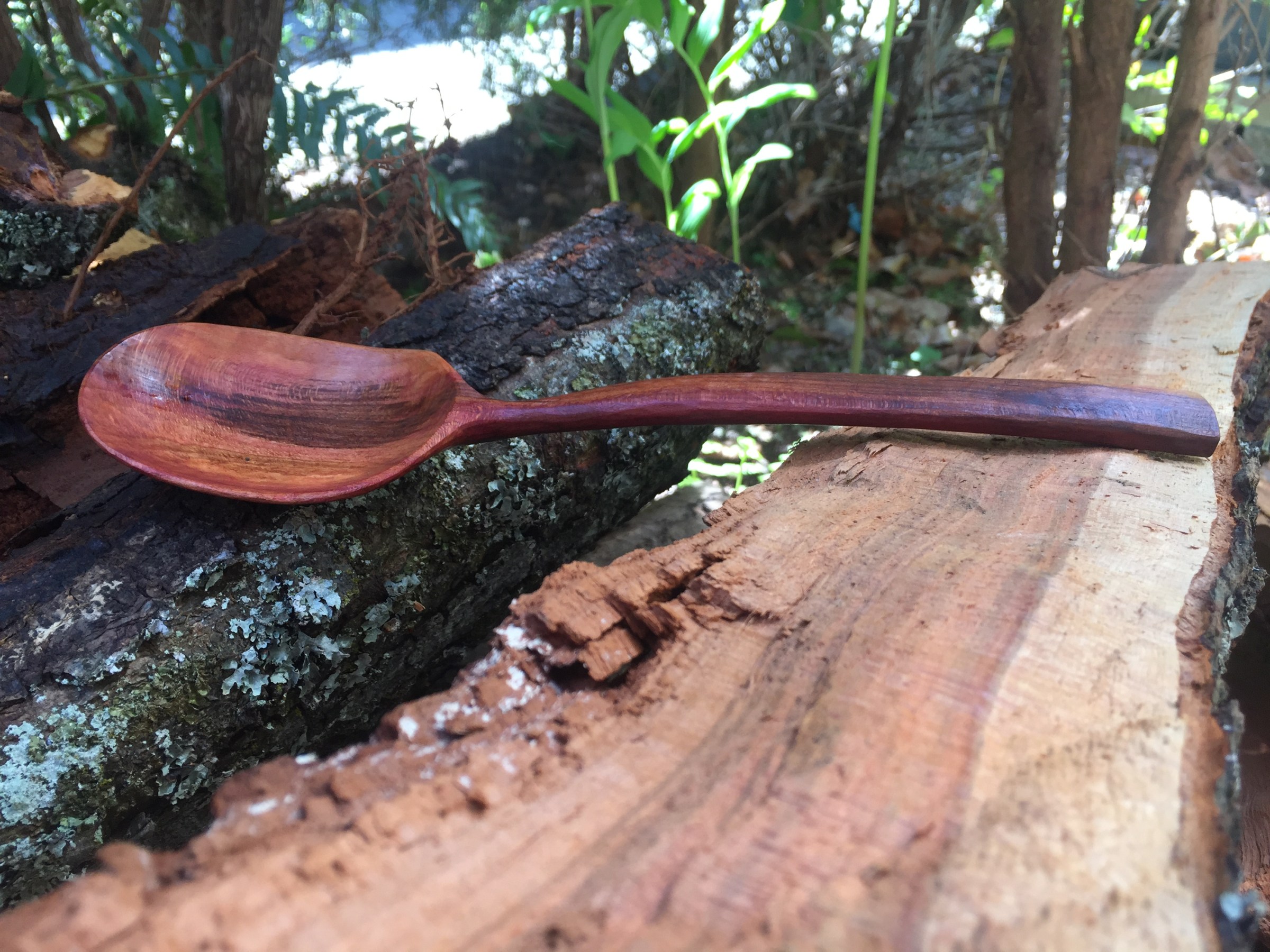
I’m doing something a bit different here today and sharing photographs and words by someone else – my friend Emily Smith who I have known for more than twenty years (and in more than one life and location, our lives have wound around each other’s in different ways and I hope one day she ends up on Gabriola). Last week she mailed me a beautiful, hand-carved spoon made from cherry wood and included a note to go with it. Both her beautiful hand-work and the note touched me very much, and exemplify the reasons I believe re-learning our historic arts are so important to reconnecting with the life around us and our humanity.
Dear Megan
I hope you enjoy this spoon and get many years of use out of it. I designed it to be small enough to serve you and Brian, but envision it being large enough to serve at one of your wonderful dinner parties once the pandemic is behind us.
It is spalted cherry from a boulevard tree at East 52nd and Doman Street in Vancouver. The fungus that caused the tree to rot also made extra strips of colour in the wood, causing it to become even more beautiful. This piece of wood also has some unusual pressure lines – although the grain runs top to bottom, if you look in the bowl you will see horizontal stripes. The tree endured a lot of stress at some point which caused the wood fibres to compress and wrinkle. I encourage you to look at the spoon in the sun to enjoy the incredible colours and patterns in this wood!
The spoon is coated with a layer of organic safflower oil. To care for it, wash by hand only. If it becomes dull and you want it shiny again, apply a thin layer of safflower, walnut, linseed, or hemp oil, wipe the excess, and let dry in an airy, sunny spot for a day or two until the surface is dry.
I made this spoon with an axe and knife and no sandpaper. It is not perfect, but it was really good practise, and probably my best spoon to date. There are so many wonderful things about making items one can use – as you well know – and it brings me great pleasure to gift this to you despite its small imperfections.Happy Springtime! Emily
Emily Smith – Spoonmaker

Post #3234: A trip to the dentist, and money well Spent
Well look at that, it’s Friday again. The last Friday of the month which makes it a Comfort for the Apocalypse day (Issue #19). Now that’s out of the way, I need to get on recording some violin tracks this weekend for Brian’s latest album project.
The past week has felt quiet, even though I had to go to Nanaimo for a dentist’s appointment. Going to town for things has not been on my radar lately, and I had forgotten that with all restaurants shut, there is little to do but walk around while waiting for entry to things. Because of the way ferries work, I had an hour to kill before my appointment, which I spent walking around the old neighbourhoods above downtown and I was struck by how much that part of Nanaimo reminds me of Victoria in the 80’s. Esquimalt and Vic West still have a bit of that older (Edwardian, WW2,) house thing going on, and it makes me nostalgic for a time when everything wasn’t shiny condos and uber-modern houses.
During my pedestrian travels I discovered that my new dentist is close to The Common Foundry, which a friend posted online about recently. To reward myself after the tooth cleaning (yuck), I went back there to investigate their small, beautifully curated collection of stationary, pencils, paperclips, and fountain pens. I won’t tell you how much I spent, but I can tell you that my quality of life is greatly enhanced with high-end pencils and cotton paper to write notes on.
In addition to the stationary supply, I also bought a 5000-yard cone of fine silk for weaving with. I was discussing plans to weave a very fine, overshot shawl in the future with one of my weaving-neighbours and she told me that she had the right weight in white silk for my project for sale! Even though I don’t plan to weave that shawl right away, I took it as a sign that it really should be on the agenda this year, and so I swung by yesterday for a visit and yarn purchase. True story is that I had a very spendy week all round.

I have been weaving a lot this week, with a cotton-linen warp on my loom I am just now weaving off the last of four hand towels for the bathroom. I also finished knitting a shawl that I started six weeks ago, and it is packaged up to go out as a gift later today. I had not planned it as a gift when I started it, but for reasons related to the timing, it become apparent to me that it was meant for someone else. Still, when I put it on yesterday after blocking, it was hard to take it off and fold it up in the bag to go out. That likely means I’ll be making another one in slightly different colours. This is a pattern by Isabell Kraemer – whose knit designs I adore.
There are more handmade gifts on my near-term agenda, plus dish towels, napkins and a sauna towel for myself. After a long absence from weaving, I’ve returned to it a bit rabidly – which is funny given that spring/summer is when I should be outside! If this continues into the warmer months than I probably will set my small loom up on the deck as it’s easy to move with a bit of help.
Work has been strangely quiet this week owing to a number of folks being away sick and dealing with family crises. Since I have next week off (for a union convention, not vacay), I’m just as glad for time to tidy up my paperwork and get things in order – but I do prefer being on a team that is active and vocal – the opposite of where folks are at the moment. On the other side of things, there have been a couple of union blow-ups lately, including one that has me questioning whether I should just leave my position as local president now. Of course that won’t happen because I always fulfill my obligations, but am I ever ready to quit that role.
One highlight of the past week was getting out for an evening kayak on Monday. The tide was up, the water was like glass, and the rain stayed away long enough to get out and paddle in the sunset. That’s twice that I’ve had the boat in the water this season and I look forward to a lot more paddling in the near future. I finally got a rack for my car so it will be safer to travel distances with the kayak (right now I just strap it down to the cross-bars, which is fine for short distances but not highway driving). I am hopeful that with the vaccine roll-out we’ll be allowed to leave home for little trips this summer and fall. I have a few days booked on Cortes with a friend and plan to take my kayak and paddleboard both!
I am definitely feeling a little lonely and sad lately, though perhaps it is just nostalgia for the way things were eighteen months ago. I really do want to be able to come and go, see friends and family, plan all the fun things – and even though my shot is coming soon (May 9th!) I know that it will be some time before things are socially more relaxed. I worry too that with the variants, we may never be truly ahead of this thing. What is happening in India right now is nothing short of horrifying, and we know that many mutations will result (as they have everywhere that the virus has proliferated), some which may be even further out of our control. I am sure not going to be one who cries about lockdown when I have the privilege of a home and all the distractions I want. But still, this long emergency takes its toll in big and small ways and I’m feeling it this week as we wait in the queue to get the vaccine.
I hope that all of you are finding ways to stay safe and support others out there! The only way we’re getting through this is together, even if we’re mostly apart.
Post #3233: Beach Fort

Someone put an awful lot of effort in to building a lean-to fort on the beach down the road from my house. Inside, they left this note held down by rocks on a small table:

We live in an area with a lot of wood refuse, the tides and inlets trap logs that escape from the booms or wash off other beaches close by. Driftwood forts are not uncommon on BC beaches. But this one is more impressive than any I’ve seen before – larger and with more structure, artful in its overlay of logs. Inside it feels stable, though I don’t trust makeshift shelters built by strangers and so wouldn’t camp in it overnight, but it *is* well above the high tide line. There is evidence of small campfires close by which makes me think that perhaps the builders did sleep overnight, though the evening I found the fort no one else was around.
I don’t know how long this fort will last. Some responsible grown-up is bound to come along and knock it apart out of concerns for the safety of small children. Or else the waves will come up and shift things in such a way that it becomes unstable and collapses in the next gust of wind. Such projects are temporary which is what imbues them with magic.
This fort existed four days ago and I wonder now if it is still there. The next time I go to that beach I will tense as I step off the trail, hoping it continues. I will hold my breath until it becomes driftwood again.


 Red Cedar