Red Cedar
More apocalypse, less angst
The next project……

And in case you were interested – with all my newfound “getting it” on the crochet front – this is the project I am starting on the weekend (from the book Contemporary Crochet). It’s easy and tricky at the same time…. the actual crochet stitch is basic, but the shaping and decreasing and what not it all new to me. I’m going to attempt to finish this for the Ravellenics deadline of August 17th – since why not? It would be lovely to have a wool/silk/bamboo wrap for early fall.
The willingness to get it wrong.
It may be a groggy Friday (friends over for dinner last night, much wine consumed), but already today I had two Eureka! moments in totally unrelated areas:
- Crochet (it’s clicking suddenly – I can read my stitches – my crochet is coming out the way it is supposed to); and
- Fishing (the act of fishing I’m still learning about, but I realized that years at my job has taught me how regs and notices work, which is allowing me to teach other people).
And if there is any connection between those two things, it is the realization that my crocheting and needlwork make me a natural for knot-tying, a fishing essential which I am dedicated to learning this summer.
It seems so often we plod along, doing things badly or not quite understanding them for a long time…. and then (as if by magic) the brain reaches some integrative capacity and the knowledge or skills suddenly spread out and make sense. Like learning how to drive — for a long time you have to think through every gear shift, signal-flick, and brake applicaton — but then comes the day when you get in your car and instead of labouring through a mental process, you auto-pilot through the tasks. The brain and body integrate in such a way that driving feels like second nature.
Which just goes to show that the longer we hold our attention on certain areas, even if the practice is awkward and full of mistakes (and we show little “natural” aptitude), the more likely our bodies will integrate our learning. It is from that point we can actually ascend, improvise and strengthen – become good at – whatever it is we are attempting.
And there is no limit on how or when we do our learning: my mother (who is near-seventy) recently took up crab fishing and clam digging to great success… my partner is involved with a group of people teaching each other about hunting as they teach themselves….. my brother and sister-in-law recently hatched 35 chicks with little notion of what they were doing when they put the eggs into the incubator.
What I see about all this skills-acquisition around me is this: it takes a willingness to risk getting it wrong until you one day get it right.
When I was younger, my sense of self was so poor that I pretty much refused to learn new things. If I wasn’t good at it already, I wasn’t interested in learning how for fear that I would make a mistake and look foolish. But around thirty, that began to change for me – at the age of 29 I learned how to drive, a bunch of outdoor skills, and how to live alone for the first time in my life….. and ten years later I can say that this entire past decade has been about building from those things to develop a much richer life than I ever could have imagined. Just in the last year I have started a graduate degree and a certificate program, have begun learning how to fish, and have develped basic skills in crochet and garment-sewing. And no, I am not an exceptional person, nor do I possess many natural talents (or any except for that I’m a fast reader) — but what is true about me is that I want to get as much out of my short time on this planet as possible and that means taking some risks (and learning in the process).
Few people say “I don’t like to learn new things,” but many will say, “I don’t like to do things I’m not good at,” which amounts to the same thing. Skills are rarely natural, and even those which do arise organically still need work and polish to become truly useful. Our society puts too much emphasis on the myth of being born a “natural”, and not enough on the reality of the “10,000 hours” it takes to become an expert – and it is this myth we hear whenever someone claims “I could never learn to do that.” (I hear this about sewing from other women all the time…. but your must trust me when I say if I can learn to sew, anyone can learn to sew. I have never found anything I have less natural aptitude for, but I am still wearing a me-made garment as I type this).
Digressions aside, the best thing about my life these days is all the new stuff I am learning, doing, and becoming proficient at. The things I’m already proficient at are enjoyable, but don’t hold nearly the discovery-potential that new activities do – and I realize that if I hadn’t got over my fear of being bad at things ten year ago, then there’s a whole lot I would have missed out on between then and now – which goes for my future as well. It’s scary, and often frustrating (I am not a patient learner) – but when I look at the diversity of the last ten years, the rewards certainly outweigh the risks!
Reconfiguring the classics – a Max Richter short.
[youtube:http://www.youtube.com/watch?v=qTapNp-31rU%5D
A little musical geekery for those of you interested in classical music, minimalist music, reconfigurations of the “greats”, and the ever-interesting Max Richter. The fact of having to wait until 2013 for this album release is a bit maddening on the heels of this teaser video – but wait I will, in anticipation of hearing Vivaldi turned inside out. An ambitious project from one of my favourite contemporary composers – Richter actually undertook to rewrite the Four Seasons on a note level – leaving in the main figures and patterns which make Vivaldi’s music so recognizable to our western ears, while changing (as he says) 3/4s of the notes in the score. This seven-minute video gives a bit of the story and a taste of what that project has in store musically.
Photographs from the Wacky Woods (Fanny Bay, BC)

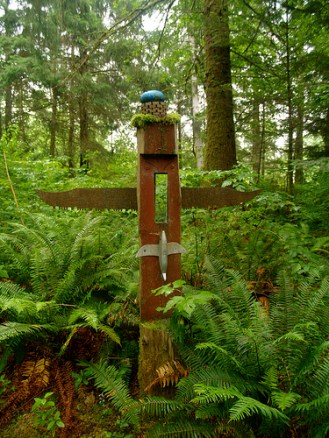
On our recent vacation, we stopped at the Wacky Woods on our way out of Fanny Bay, BC. It was a quick jaunt into the forest to show our friends the outdoor installations of the late George Sawchuk – but the sheer volume of work there never fails to impress. Humorous, provocative, penitent and sometimes melancholy – the passions and social critiques of Sawchuk are writ large on these woods – his legacy being a real community treasure. Though I have not got the rest of our trip photos online, I did put up a gallery from the Wacky Woods last week. Interested in more about Sawchuk? See this post that Brian penned after we visited the artist’s studio in 2008 when he was still very much alive.
Crabbing at Belcarra
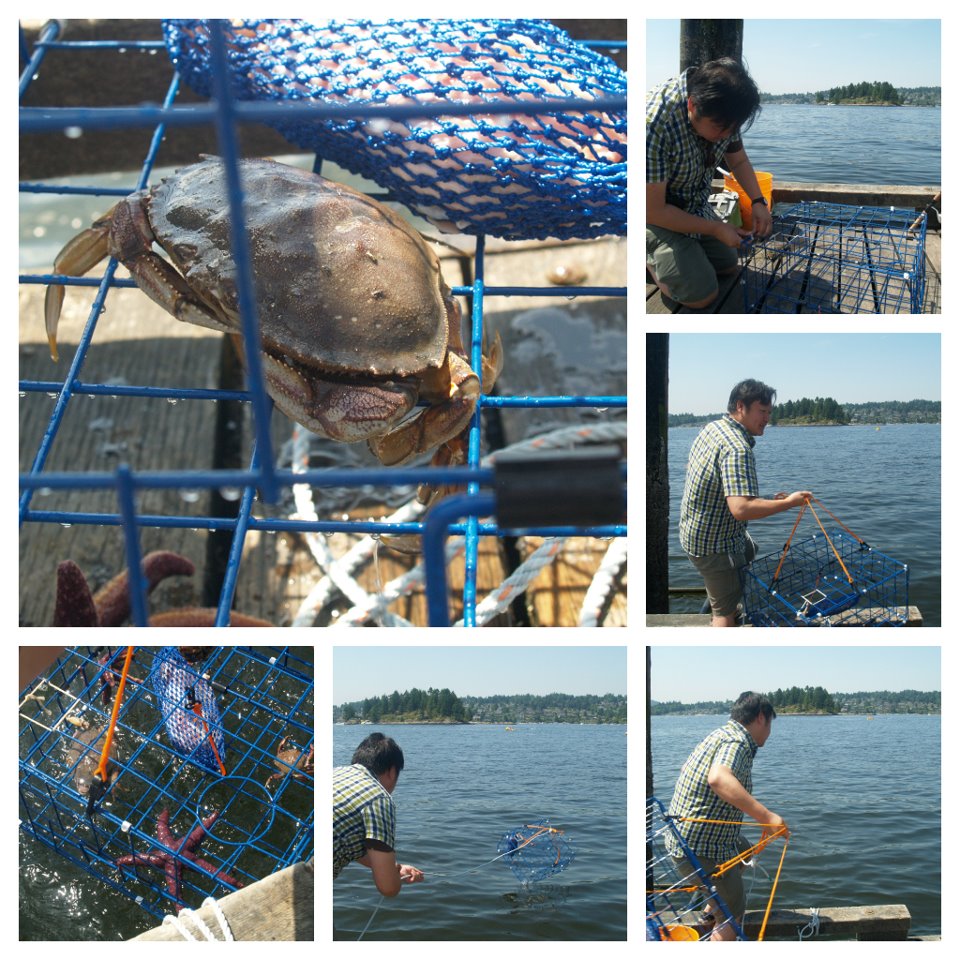
As part of expanding our access to local food year round, Brian and I have taken up fishing in the last year. Lake fishing, mostly trout so far, but we’re interested in expanding into saltwater – and I’ve got a nascent interest in flyfishing that I might investigate this fall when I accompany Brian on some hunting expeditions (I don’t hunt, but I’m thinking it’s the perfect opportunity for some fishing and photography).
So! In keeping with the get-out-and-learn-new-stuff-about-food theme, we went to Belcarra on Saturday with our friend (who just bought a crab trap) Leung and spent the afternoon on the sunny dock getting nicely toasted (read: burned) while waiting for the crabs to take our bait. In general, I would not recommend Belcarra on a sunny Saturday as the pier is overcrowded – but for a first time it was excellent because 1) they have a park employee and volunteers out there on the weekend to answer all your questions and 2) there are so many people crabbing that you get a real feel for the variety of traps and techniques out there.
While we didn’t catch anything we could keep (all female and/or undersized), I did come away with a lot of confidence for doing more crabbing in the future. If you are interested in heading out for an afternoon of crabbing in the lower mainland, here are some things worth knowing:
- By law you must carry a tidal waters fishing licence issued by Fisheries and Oceans Canada. If you intend to also fish for salmon, you must also purchase the salmon conservation stamp – total cost is $30 for the year.
- Crabbing is best done at the turn of the tide, about two hours after the low tide point when the crabs are moving in with the water.
- Crabbing may take place from shore, from a pier, or from a boat. If you are working from shore, you will want a lightweight trap that is easy to throw a long distance – I like the half-circle traps in particular and will probably invest in one of those even though they require more tending than the larger traps that are dropped from the pier or a boat. Traps can range from $20 (for the square traps at Army and Navy) upwards to a few hundred for commercial traps. The $20 traps work fine if you’re dropping them off a pier.
- Dungeness and Red Rock Crabs are what you’re after in BC, and it is against the law to keep females and those which don’t meet a certain size across the carapace.
- Crabs are most often found in bays and estuary zones, so plan your trip accordingly.
- If you use fish for bait, seals will eat it – chicken is attractive to crabs without attracting the marine mammals.
As with anything there is lots ot know about trap types and locations – but it turns out that the crabbing itself is really very simple. Bait trap, drop or throw it in the water, wait (15 minutes with the half-circle traps, one hour or longer with the drop traps), pull in and discard whatever you aren’t allowed to keep. You can use tongs or work gloves to minimize risk of being pinched, or simply pick the crab up from its back end so the claws are out front. Also picking it up from the top of its carapace and turning it upside down is another way to avoid claw injuries.
Obviously this is a popular time for outdoor activities, so crabbing anywhere on a weekend is bound to be busy. We’re hoping to take advantage of my Mondays off work, and our willingness to go out in the dismal months of late fall to get some quieter and more productive crab fishing done.


 Red Cedar