Red Cedar
More apocalypse, less angst
Post 3294: Drawing practice

A big part of my personal story is that as a child I learned early on I did not have the skill for drawing or other visual arts. This was evidenced by a note on my Kindergarten report card which read, “Megan lacks hand-eye coordination when using scissors,” and was proof enough in my family that my skills were to be found in other areas, such as writing and playing the violin. At the time, my parents believed that one best work with our natural proclivities rather than spending too much time on skills where we showed poor aptitude.
This never felt like a big deal to me. As a child with a mercurial temperament I was frustrated by things that did not come easily. Drawing and painting fell into that category – I had a hard time even colouring inside the lines on pre-printed sheets – so it didn’t seem much of a punishment to be deterred from spending time making art. My brother had more natural talent for drawing and so he got to be the artist; I got to be the writer/musician, and thus our family roles were set.
For all of my life until I turned thirty, I did not make art unless I was forced to in school projects (which always turned out miserably). I did pick up a few technical skills in my twenties, teaching myself how to cross-stitch using patterns from books, and learning how to use a sewing machine, but it wasn’t until I started quilting and sewing in my early thirties that I started to explore a bit more. At that point, I still believed that I would never effectively learn how colour or composition work because of my innate artistic deficiency. Even though I knew from years of making music, that the key to learning most things is practice and repetition, I saw art-making as separate and somehow related to genetics or inborn skill, and thus inaccessible to me.
*
One of the substacks I love is Draw Your World by the very talented Samantha Dion Baker. As someone with no skill for drawing, I am mesmerized by those who can turn a few lines into something meaningful.
In February, right around my 50th birthday, I won a draw via Samantha’s Substack (exciting!) and she mailed me a set of Derwent watercolors and a set of water brushes. At the time, I figured I would use them for application on textile, as I do occasionally use watercolors on fabric when making a textile piece. I was very grateful for the gift.
Not long after that I started taking a local, in-person workshop called “The Healing Power of Art” which has encouraged me to take up a kind of meditative drawing on a semi-regular basis over the last few weeks. Nothing figurative, with no intention to make “art”; I journal a bit, and then I draw a bit, sometimes incorporating a phrase that comes out of my writing.
It might look something a bit like this:
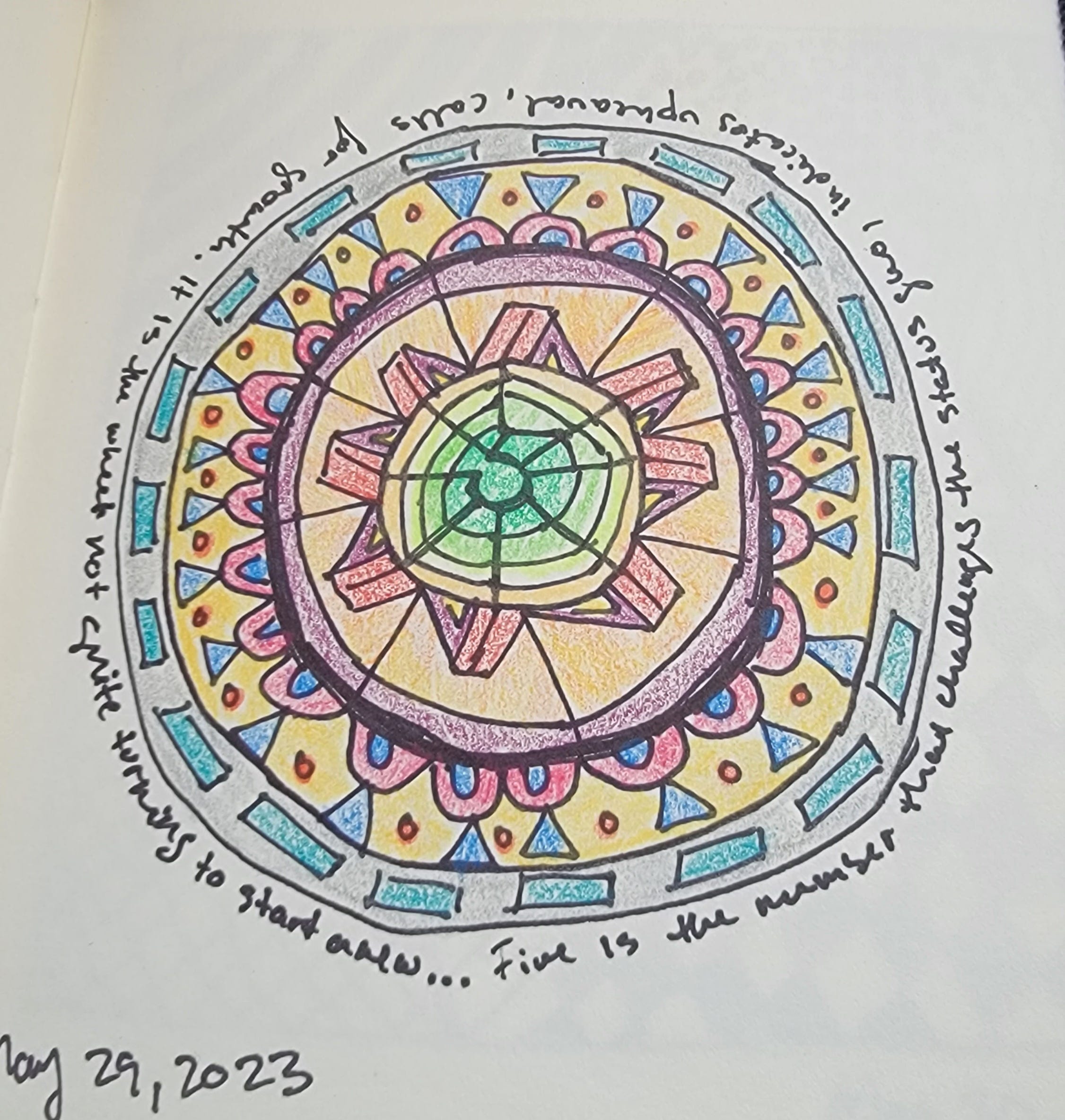
As you can see, there is no sophistication here. I draw like a six-year-old (likely because I stopped drawing entirely around that time of my life). But my total lack of skill allows me to turn off the inner critic in a way I don’t with pretty much anything else. The act of drawing gives me a period of focus, and no expectations leaves me pleased with almost any result.
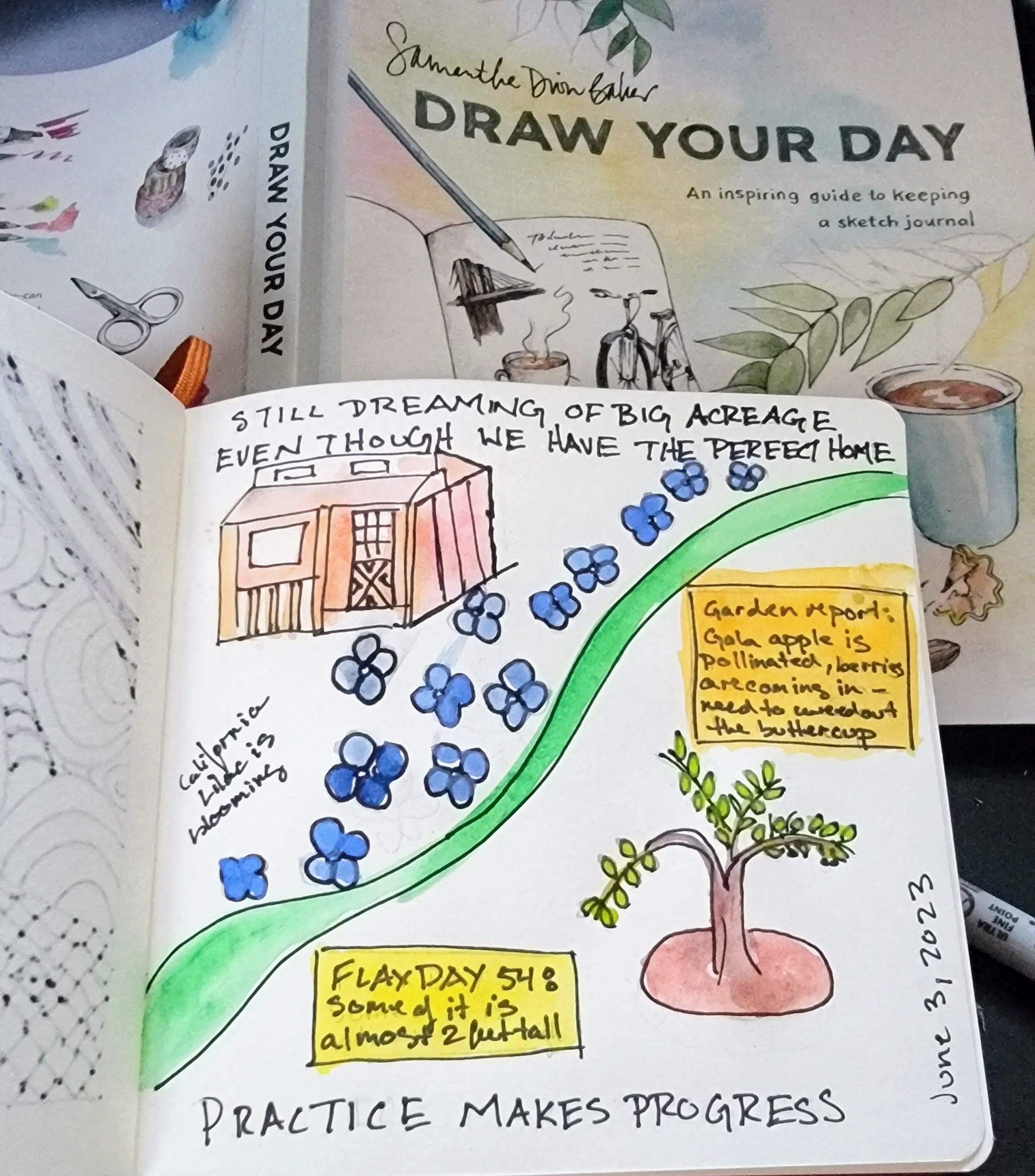
All this recent drawing reminded me of the watercolour set in my drawer, and that in turn reminded me of Samantha’s book Draw Your Day which was sitting in my studio “to-read” pile. In it, Samantha encourages a practice of visual journaling, using drawing, watercolour, and collage techniques to make a record of the day. Her Instagram, books, and courses are full of positive affirmation, technical tips, and inspiring artwork – and somehow I’ve found myself yearning to learn how to draw figuratively, at least a little bit, so I can add some colour and texture to my written journaling practice.
Over the years, I have collected up good pencil crayons, pencils, waterproof pens, and ephemera for collaging because the impulse to draw and decorate has been there for a long time. I didn’t have to invest in any supplies to get started when I decided to get over myself and just start practicing!
It’s been ten days of daily drawing practice and so far what I’ve learned is that I really *don’t* know how to draw. That is, I struggle with looking at an object and knowing how to represent it in lines and colour. My pencil strokes are not confident, I can’t freehand a circle to save my life, and perspective is an elusive concept. However! I find the practice completely absorbing (an hour or more can go by and I barely notice), my drawing has improved a little in just a few days (easy when there is so much room for improvement), and I’m learning to see my world differently as I move through my days looking for basic stuff I can draw. I’ve realized it’s much easier if I draw from an object or photo, rather than from my imagination – so I snap a lot more pics with my phone during the day to keep as a reference. And I’ve discovered so many “how to draw” YouTubes, and Skillshare courses on lettering, drawing and watercolouring, that learning some basics is practically free.
Most importantly for learning is that I have become a bit obsessed in the last couple of weeks – which is what it takes for me to put other things aside and pull out some paper. I don’t have big expectations except that I learn to express myself visually for my own enjoyment – and I’m finally at a place where I can drop the baggage that has weighed me down in this area for so long.
Below is my first attempt at a “Draw Your Day” page which I have followed up with other kinds of sketch and journaling exercises. This is such a portable practice that I plan to take it on the road over my summer holidays to see what comes of it.
One Comment on “Post 3294: Drawing practice”
Leave a comment


 Red Cedar
Nice! you might enjoy Danny Gregory’s book “Creative License.” It’s very up this alley. Hope you’re well! Cheers, Lori